I'm working on a Space Marine army for Warhammer 40k at the moment.
It was one I bought second hand off a kid for the Princely sum of £70. At the time I decided only to keep the bits I liked, and sold on a variety of bits and pieces from it (rule book, non-space marine bits, scenery, units I didn't like, etc) I sold those off for £85 in the end, so by the time I'd bought a few oddments I wanted (some quite pricey) a 2000pt army had cost me about £25 all in.
The down side of buying a child's collection is the state of the models. On the one hand you have a lot of things still unpainted, or even still on their sprues, great! On the other, where paint is applied, it is done with a two inch brush or the figure is simply dipped in a pot of acrylic paint and allowed to solidify. It's a technique I recall from my youth too.
Some of the poorest figures spent two weeks in a Pine-oil based cleaner, before most of the paint came off. When I am able I'll have some photos to show the sorry state of one particularly bad model.
Anyway, although I did paint one unit from them over a year ago, they had languished for some time. Motivated by a defeat of my Orks by Space Marines, yet again! I was inclined to start on them again.
'Footage at eleven...'
More shocking was the value of this little force.
at today's prices, my 65 figures and three vehicles worked out at...
Wait for it...
£258
Yes, £258, I nearly fell off my chair at that one.
Games Workshop, eh?
Friday, May 25, 2007


Tuesday, May 15, 2007
Book Report
Just recently, I finished plodding through Thucydides "History of the Pelopenessian War", something of an epic for the lunch break and evening commute, six hundred pages of rather heavy going. I also dread to think how much longer it might have been if Thucydides had actually finished it; the two page summary of the war in the back of my Collins Atlas of Ancient Greece was much snappier (skimped on the details a bit though).
As a rule I don't read many narrative military histories. Not enough time for them, seeing as they have to compete with reference books ("Osprey's" and the like, so much more useful for a wargamer/military historian), books on general history, archaeology, science, the paranormal, novels and magazines. I maybe manage one a year, and this was it for now.
T'was a good read mind, lots of detail on naval engagements, and a few choice battles. It highlighted the rather distant passive nature of the Spartans, which is a good counterpoint to any opinions formed solely by watching/reading '300'. Generally it's pretty balanced too. Thucydides writes in a recognisably modern historical style. Indeed he is cited with inventing it, not for him musing on the gods influence in the affairs of man.
Incidentally, last years' book was Robert Harveys' enthralling "Liberators: Latin America's Struggle for Independence, 1810-1830 ". Another doorstop of a book that kept me ticking over for months. When looking for Napoleonic style warfare on an addressable scale I picked this up (and the relevant Osprey book too), as South American history is another area of interest for me. Lengthy it may be, but it's a rip-snorting read (as people in the thirties would probably say). Simon Bolivar was an incredible general, and Harvey does justice to his and other commanders' talents (and gives wings to the inspiration of wargamers - with excellent accounts of the actual battles) in the narrative. The real revelation of the book, for me, is Thomas Cochrane, 10th Earl of Dundonald however, a disgraced British naval captain, who invented every trick in the book, and Harvey argues (in another book on the man) was the inspiration for the entire genre of naval daring-do fiction.
Two good books, worth a go if the periods are of interest to you.
In other news, the home PC is still up the swanney, so no pictures. The Valiant figures I bought last week are now all painted and ready for EBay. No club this week either, so time for even more painting; some Vikings to finish - which I wish I'd never started - and then I can get on to better things...
As a rule I don't read many narrative military histories. Not enough time for them, seeing as they have to compete with reference books ("Osprey's" and the like, so much more useful for a wargamer/military historian), books on general history, archaeology, science, the paranormal, novels and magazines. I maybe manage one a year, and this was it for now.
T'was a good read mind, lots of detail on naval engagements, and a few choice battles. It highlighted the rather distant passive nature of the Spartans, which is a good counterpoint to any opinions formed solely by watching/reading '300'. Generally it's pretty balanced too. Thucydides writes in a recognisably modern historical style. Indeed he is cited with inventing it, not for him musing on the gods influence in the affairs of man.
Incidentally, last years' book was Robert Harveys' enthralling "Liberators: Latin America's Struggle for Independence, 1810-1830 ". Another doorstop of a book that kept me ticking over for months. When looking for Napoleonic style warfare on an addressable scale I picked this up (and the relevant Osprey book too), as South American history is another area of interest for me. Lengthy it may be, but it's a rip-snorting read (as people in the thirties would probably say). Simon Bolivar was an incredible general, and Harvey does justice to his and other commanders' talents (and gives wings to the inspiration of wargamers - with excellent accounts of the actual battles) in the narrative. The real revelation of the book, for me, is Thomas Cochrane, 10th Earl of Dundonald however, a disgraced British naval captain, who invented every trick in the book, and Harvey argues (in another book on the man) was the inspiration for the entire genre of naval daring-do fiction.
Two good books, worth a go if the periods are of interest to you.
In other news, the home PC is still up the swanney, so no pictures. The Valiant figures I bought last week are now all painted and ready for EBay. No club this week either, so time for even more painting; some Vikings to finish - which I wish I'd never started - and then I can get on to better things...
Tuesday, May 08, 2007
Where your Council Tax goes...
I 'm trying to keep this blog more regular than it was in the 'winter season', but it's not helped upgrades to the home PC kill your internet connection. Still work has its uses!
It was a 'Bank Holiday' here in Britain yesterday, so extra time off all round. To be honest I seldom work a monday between late April and June anyhow, but that's council work for you.
No games to report, but I did get some painting in, when not cursing my computer. I managed to finish a Necromancer, who'd been sat on the painting table for 6 months awaiting some attention. I'll post shots when I can, as he's pretty nice. Commendable work from the Acrylics again.
I also knocked off a dozen Ork warrios for 40K. Recent battle experience has shown I just can't field enough Ork Boys to make classic Orky tactics (charge, accept huge losses on way in, once in contact, beat all comers to a bloody pulp) work. I'd intended painting them quickly, but not 'speed painting'; so they ended up with three layers of wet-brush to dry-brush highlighting, and extra detailing. Frankly more labour than cheap plastic figures bought off E-bay to bulk out my forces really warranted. Oh well.
Also over the weekend I picked up a set of the new Valiant Miniatures German infantry. You can tell that even as '20mm' plastic figures, these guys were put together by wargamers. They are hard plastic, multipart, chunky and tall. Average height foot to eye is 23.5mm. On the plus side the box contains all the parts to make a full Rapid Fire battalion of infantry, plus a force roster showing you what it would comprise (no points values, but hey, they ain't giving you the rules for free are they? Well actually they do on the rapid Fire website!). You get enough spare figures to assemble a couple of dozen other figures too. Plenty of heavy kit too - MG42's on sustained fire mountings, 80mm Mortars, Panzerfausts. Some of the posing is a bit static, but overall the best way to start a force. Only £9 a box too.
Check out their website here: http://www.valiantminiatures.com/
Personally the battalion is going to be painted up and stuck on E-bay; that still leaves me all the mortars and machine guns my Germans could ask for.
Now, if only I could get my home PC to work...
It was a 'Bank Holiday' here in Britain yesterday, so extra time off all round. To be honest I seldom work a monday between late April and June anyhow, but that's council work for you.
No games to report, but I did get some painting in, when not cursing my computer. I managed to finish a Necromancer, who'd been sat on the painting table for 6 months awaiting some attention. I'll post shots when I can, as he's pretty nice. Commendable work from the Acrylics again.
I also knocked off a dozen Ork warrios for 40K. Recent battle experience has shown I just can't field enough Ork Boys to make classic Orky tactics (charge, accept huge losses on way in, once in contact, beat all comers to a bloody pulp) work. I'd intended painting them quickly, but not 'speed painting'; so they ended up with three layers of wet-brush to dry-brush highlighting, and extra detailing. Frankly more labour than cheap plastic figures bought off E-bay to bulk out my forces really warranted. Oh well.
Also over the weekend I picked up a set of the new Valiant Miniatures German infantry. You can tell that even as '20mm' plastic figures, these guys were put together by wargamers. They are hard plastic, multipart, chunky and tall. Average height foot to eye is 23.5mm. On the plus side the box contains all the parts to make a full Rapid Fire battalion of infantry, plus a force roster showing you what it would comprise (no points values, but hey, they ain't giving you the rules for free are they? Well actually they do on the rapid Fire website!). You get enough spare figures to assemble a couple of dozen other figures too. Plenty of heavy kit too - MG42's on sustained fire mountings, 80mm Mortars, Panzerfausts. Some of the posing is a bit static, but overall the best way to start a force. Only £9 a box too.
Check out their website here: http://www.valiantminiatures.com/
Personally the battalion is going to be painted up and stuck on E-bay; that still leaves me all the mortars and machine guns my Germans could ask for.
Now, if only I could get my home PC to work...
Tuesday, May 01, 2007
Photo Bonanza - Thracians
My Thracian army is one of my favourites.
More light cavalry, with noble horsemen to the rear.
One of these days I'm going to get round to ading more horse and massed infantry, the figures are already there; but as it stands, this is a complete force.

Assembled over a few months in 2000-01; It comprises at present 132 infantry and 18 cavalry; along with three general stands. It was assembled for playing armati, but works well for DBM and Warhammer ancients too.
Above are Thracian slingers, typically from the shepherds and farmers of the society. These are converted Hat Spanish slingers.
Other skirmishers; most of the army is sourced from the Hat Thracian allies box, supplying virtually all the infantry.
Part of the mass of the infantry. The guy front and centre with the wicker shield is Zvezda (from their Greek warriors set) the rest are all hat.
The painting technique is my usual speed style, using flat colours and a varnish glaze; the only variation is that I used brown as the shading mix at a proportion of about one part Humbrol German camouflage brown (pot: 170) to 30 parts Humbrol mattcote varnish. Obviously, sing flat colours did not preclude me including plenty of patterning on these figures. The Thracian's loved colourful and complex fabrics, apparently!
The overall general, based on Angus McBride's image of King Kotys (Men at Arms book 360). To look the part, Zvezda's Alexander (from their Greek Cavalry set) underwent a head swap with the javelinman next to him.
Light horse of the plains, Again figures from the Zvezda Greek cavalry set supplied all my needs. Thracian's aped and looted Greek armour styles with just a few indigenous features.
More light cavalry, with noble horsemen to the rear.
One of these days I'm going to get round to ading more horse and massed infantry, the figures are already there; but as it stands, this is a complete force.
Saturday, April 28, 2007
Operation Overlord

I bought these rules last year looking for something to replace my old WWII wargames rules; they came in a pretty boxed set, with reasonable production values and promised to allow simple, fast dynamic games. So we tried a scenario from the rules and found them to be rather, well murderous. Initially my players dismissed them, and so did I, but after a year or so I dug them out again to try with my 28mm's, and lo with a bit of reason, they work!
Actually this overlooked set of rules work pretty well.
I say overlooked, because they don't come from the usual stable of wargames rules producers; they may well be quite popular, but as they are made available in Britain via a model company, and originally herald from Italy (it certainly shows in some of the rule translation), they've passed the hardcore gamers by.
I do suspect an awful lot of people who never wargamed before are using these rules though, because of the way they've been marketed. And that is no bad thing. The rules themselves are a slim affair, suffering as stated from some vague translation, and, until you make the sensible revision of classing all terrain except roads as light cover, murderous.
What makes them work is the card system. Each player commands his forces through the turn by use of a hand of cards. Playing a card to a unit and declaring its' actions. The thing is any card played has an initiative value on it from 1 to 6; if the opponent wants to interrupt the player, he simply provides an order of a lower initiative value to one of his available units. The first player may respond in kind too, so you get a tit for tat style of action that allows for real uncertainty and some subtlety, without the need for written orders or arbitrary dice rolling. Genius!
So the game, the second with my 28mm's and these rules, saw Chris leading an American motor rifle platoon with an attached Tank Destroyer to clear a small village, somewhere in Northern France. Brian played the defending Germans; a reduced platoon of grenadiers, with an anti-tank gun and an armoured car in reserve.
 The end of the American advance; the crew of the lone half track have just seen their occupants raked my machine gun fire
In paper strength the Germans were outnumbered two to one, but in reality they were able to stall the Americans easily with only a portion of their strength. The Americans lacked the will to come forward in strength, instead focusing on crawling through cover. Incredibly though they managed to miss the hidden enemy in buildings, who destroyed their command squad with well aimed machine gun fire.
 Americans advance through the woods
The Americans tried to rely on their mortar to bail them out, but it could see very little and the radio crews were having no luck directing it. What they wouldn't do was risk their tank, though the Pak 40 proved completely incapable of hitting anything
 A German squad, high above the lie of the land observe the Americans advancing into the open: 'Auf meinen zeichen, lassen sie Holle los!'
 In the end the physical losses were similar, about 10 casualties each, but there was no hope of the Americans having the will to attack further and the game went to Brian's sensible control of the ground.
It was another big toys game for the club, and pleasing for me as it was the first full outing for my American Motor Rifles. Four Solido/Verem M3 half tracks clock in at a cool £80! All I need now for my 28mm WWII is a sprinkling more of American infantry, and I can call this lot done and dusted.
Monday, April 23, 2007
Penrose Field, 1644
Another battle in the English civil war, utilising the excellent Peter Pig "Regiment of Foote" rules. The armies were as shown below; loosely being:
Sir Percy Bovington's Royalists; of 6 companies of foote, 5 troops of horse and two guns.
Sir Bernard Wraithwaites' Parliamentarians; of 5 companies of foote, 5 troops of horse, a forlorne hope and two guns. The opening campaign system saw Lord Wraithwaite advance into Mumerset with his Parliamentarians and catch the Royalists under Percy unawares. As a consequence Percy faced an army twice the size of his own and rallied on a ridge line near Penrose church.
 The opening salvos of the battle were one sided, as Bovington had no guns of his own available; in the event one of his companies of foote ran at the first sign of accurate artillery fire, and the ridge lay empty. The only hope for Bovington was that the late start of the battle and his relative advantage of cavalry on his right flank would allow him to stall Wraithwaite.
 Wraithwaite meanwhile concentrated force, and steadily marched forward large groups of troops against the ridge and Penrose Church.
 For Sir Percy the battle began well. His cavalry beat the weaker forces facing them, and in doing so diverted the centre of Wraithwaites forces.
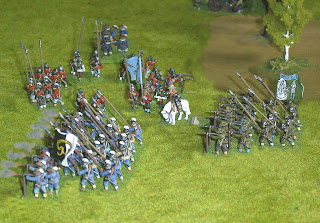
The Centre of Wraithwaites nervously gave fire.

The horse of Wraithwaites right wing redressed the imbalance on their left as best they could, whilst the centre formed a defensive perimeter to keep the Royalists at bay. The advance on the church was stopped however, and as darkness fell; the royalists were able to sneak away. The parliamentarians controlled the ground, but had suffered a bloody nose in doing so.
In real terms the rules complicated the situation greatly; Phil, my opponent, found himself with a pitifully small force, but was able to select his ground. I had little opportunity to change the ground I fought over, but fully expected to roll up his forces, especially as he had one third of his infantry run off before the battle even started. However the game in the end only lasted five turns, due to the random countdown nature of the rules. This meant that the Royalists managed to hold on, indeed they did more damage to the Parliamentarians than they could have expected to.
Thus ended the first stage of the the Mumerset campaign of 1644.
Thursday, April 12, 2007
The battle of Ostnerbuck 1380
I was accused by my opponent of showing off yesterday. His point being that I had taken pretty armies to the club once again, as if it were some sort of shop window. My view on that is why the heck not! My local club tends to have rather uninspiring looking games of an evening, saving its good stuff for shows and presumably shelves at home. I don't play that way; I like to look at as good a setup as I can. That tends to mean I take the big stuff to the club whenever I can, and you can't beat 28mm for visual impact.
And so last night it was another outing for the Medievals and Warhammer Ancients. In fact this was a really small game; 1200 points per side. I was playing a City state of the Holy Roman Empire (a western German city army in effect) whilst Chris took on the role of the Flemish. Initial deployment was something like this:
And so last night it was another outing for the Medievals and Warhammer Ancients. In fact this was a really small game; 1200 points per side. I was playing a City state of the Holy Roman Empire (a western German city army in effect) whilst Chris took on the role of the Flemish. Initial deployment was something like this:
 I had a centre focused on a hill, whilst the Flemings spread themselves thinly around woods and farmland.
 The battle as it turned out was to swing each way several times in the course of the evening (not helped by us totally forgetting to do any panic tests throughout the game). Early on, my German knights, led by the city duke charged impetously at the Flemish Placonniers. With the aid of their own general the Placonniers destroyed the knights, and already the gig should have been up. However german firepower and the slow moving Flemish pike blocks gave me time to hastily revise my battle plan, getting my mercenary Diener (light horse) into the centre.

They were to do stalwart work there; routing the enemy general and destroying the Placonniers, before going on to eliminate the Flemish organ gun. It was buying me time.
Meanwhile the Flemish Pikemen advanced steadily. One of my most recent units, Old Glory Low Countries Pikemen and Front Rank Leaders painted in the colours of the city of Damme:
 Heading straight for German spearmen. These are Black Tree figures with an ancient Citadel seargent.
 A protracted fight on my right saw the Flemish pikes win through and advance on the hill. On the left the red pikes tried the same, but were frustrated by rallying crossbowmen. This bought enough time that my Infantry on the hill could advance to face the red pikes whilst my light horse charged the white pikes.
 They were beaten off, but this drew the white pikes away from my spearmen. With the crossbowmen, my spears were able to then surround and destroy the red pikes. At this point Chris conceded defeat, in what was a very close game.
And I suppose he was also right about showing off, the terrain was nothing to write home about, but my figures attracted favourable comments from various other members; and that's always nice isn't it?
Tuesday, April 10, 2007
A win in a GW store
Rare indeed; thanks to my council still giving staff an extra day off after bank holidays (I know, shocking isn't it; I'm glad I don't pay council tax to who I work for!) I was able to squeeze a game in against some random whippersnapper in my local GW store.
I'd took along my Vampire Counts on the off chance of a game, and ended up facing a 1500 point High elf force, from memory something like this:
Foot General without anything fancy
2 Level two mages
20 or so Sea Guard with Bows and Spears
2 units of a dozen bows
2 Chariots
2 Bolt throwers
Myself I had to assemble a scratch force, thinking that Vampires didn't suit smaller games. I ended up with the following; and a deep sense of foreboding:
Lahmian Vampire Thrall with asp bow and quickblood
Level 2 Necromancer
Mounted Wight Lord
23 Skeleton spearmen with Thrall
23 Skeleton swordsmen with Necromancer
5 Black knights with a magic banner with wight lord
18 Grave Guard
9 Ghouls
2 swarms of bats in a single unit
As it happened I need not have worried; I quickly assumed I would be hammered by magic, but the elven mages did sterling work in taking themselves out the fight. One blew up early on, and the other allowed himself to be chased away by my bats. In fairness my mage was not a lot of help, only casting successfully 3 times in eight or so turns.
The Elves deployed in a classic firing line well back on the table; for my part I used terrain, ghouls and the black knights to cover my infantry force. The advance saw relatively few casualties on my troops and fear reduced the impact of the enemy charges. My opponent was also not aware that the undead don't run, so made several mistakes in rash charges which allowed me to tie-up, envelop and then destroy his army piece by piece.
At the end I had the Wight lord, Necromancer, two units of Skeletons, a few Grave Guards and a swarm of bats left. My enemy was eliminated. Funnily enough to me; some of my figures were older than my opponent!
A pleasant way to spend a couple of hours.
I'd took along my Vampire Counts on the off chance of a game, and ended up facing a 1500 point High elf force, from memory something like this:
Foot General without anything fancy
2 Level two mages
20 or so Sea Guard with Bows and Spears
2 units of a dozen bows
2 Chariots
2 Bolt throwers
Myself I had to assemble a scratch force, thinking that Vampires didn't suit smaller games. I ended up with the following; and a deep sense of foreboding:
Lahmian Vampire Thrall with asp bow and quickblood
Level 2 Necromancer
Mounted Wight Lord
23 Skeleton spearmen with Thrall
23 Skeleton swordsmen with Necromancer
5 Black knights with a magic banner with wight lord
18 Grave Guard
9 Ghouls
2 swarms of bats in a single unit
As it happened I need not have worried; I quickly assumed I would be hammered by magic, but the elven mages did sterling work in taking themselves out the fight. One blew up early on, and the other allowed himself to be chased away by my bats. In fairness my mage was not a lot of help, only casting successfully 3 times in eight or so turns.
The Elves deployed in a classic firing line well back on the table; for my part I used terrain, ghouls and the black knights to cover my infantry force. The advance saw relatively few casualties on my troops and fear reduced the impact of the enemy charges. My opponent was also not aware that the undead don't run, so made several mistakes in rash charges which allowed me to tie-up, envelop and then destroy his army piece by piece.
At the end I had the Wight lord, Necromancer, two units of Skeletons, a few Grave Guards and a swarm of bats left. My enemy was eliminated. Funnily enough to me; some of my figures were older than my opponent!
A pleasant way to spend a couple of hours.
Monday, April 09, 2007
Letting go...
So on moral grounds as much as anything else, I've put up two of my armies for sale.
In the future I may need to get rid of even more, if a relocation and downsizing of my various assets (for a radical new life) come to fruition; but at this point in time, these two were definitely taking up more space than I liked.
As a young lad world War Two was my first interest, but in the eighties there was a lot of fighting about, and much of it was on the TV. Afghanistan, The Falklands, Grenada; it's a long list. But the one that caught my eye was the Gulf war, not the Persian Gulf Distraction (as Bill Hicks succinctly put it "A war is when two armies are fighting") but the one between Iran and Iraq.
It was a hideous conflict, but as a naive teen it all sounded cool and exciting, tank battles, trench warfare, gunboat raids; oh and of course suicide attacks, chemical warfare and atrocities.
Let's be honest war itself is seldom pretty, and wargaming doesn't tend to dwell on the less savoury aspects. My games based in the gulf saw my Iranians as the heroic underdog, resisting the evil invader that was Iraq and Hussein. For a good ten years or so they were fun meaningless games based on what was going on on TV.
I got over it. I'll admit for many years I knew what it really involved, maturity came in time and whilst I've made peace with what my hobby is about, and can carry on with it, or defend it as either a simple distraction or an educational tool; I never felt quite happy about the slightly tasteless way I had gamed a war that cost a million lives for no good reason.

Of course it's an argument we could level at any wargame. But this one in particular left a nasty taste in my mouth. Not helped when the war on Terror led to round two of the West versus Iraq. By that point I was done with the gulf.

I wonder how many gamers think about the ethics of their games; I like to think of myself as a naturally peaceful man, in most respects not your typical wargamer. I'm not ex-military or militarist; I don't have a gun (no surprise in my country though) and don't have bullish political leanings. Yet I still play wargames based around all too recent history, and the implicit tragedy within that. I find despite the romance of the history, or the dark fascination with a conflict, I can't justify doing just anything any more. And wargaming the gulf conflict(s) falls beyond that line for me.
So the result, is two armies go onto ebay; much to the surprise of the missus. I feel better for clearing the space, but also I think better for clearing my conscience.
It's a line in the sand I've made for myself, and other people will think it sounds ridiculous. But for me the issues around making light of this particular ongoing conflict were not worth hanging onto a couple of boxful's of models any longer.
If you want them, they're these Ebay item numbers:
20mm Gulf wars Iraqi army: 330107396441
20mm Gulf wars Iranian army: 330107403087
In the future I may need to get rid of even more, if a relocation and downsizing of my various assets (for a radical new life) come to fruition; but at this point in time, these two were definitely taking up more space than I liked.
As a young lad world War Two was my first interest, but in the eighties there was a lot of fighting about, and much of it was on the TV. Afghanistan, The Falklands, Grenada; it's a long list. But the one that caught my eye was the Gulf war, not the Persian Gulf Distraction (as Bill Hicks succinctly put it "A war is when two armies are fighting") but the one between Iran and Iraq.
It was a hideous conflict, but as a naive teen it all sounded cool and exciting, tank battles, trench warfare, gunboat raids; oh and of course suicide attacks, chemical warfare and atrocities.
Let's be honest war itself is seldom pretty, and wargaming doesn't tend to dwell on the less savoury aspects. My games based in the gulf saw my Iranians as the heroic underdog, resisting the evil invader that was Iraq and Hussein. For a good ten years or so they were fun meaningless games based on what was going on on TV.
I got over it. I'll admit for many years I knew what it really involved, maturity came in time and whilst I've made peace with what my hobby is about, and can carry on with it, or defend it as either a simple distraction or an educational tool; I never felt quite happy about the slightly tasteless way I had gamed a war that cost a million lives for no good reason.

Of course it's an argument we could level at any wargame. But this one in particular left a nasty taste in my mouth. Not helped when the war on Terror led to round two of the West versus Iraq. By that point I was done with the gulf.

I wonder how many gamers think about the ethics of their games; I like to think of myself as a naturally peaceful man, in most respects not your typical wargamer. I'm not ex-military or militarist; I don't have a gun (no surprise in my country though) and don't have bullish political leanings. Yet I still play wargames based around all too recent history, and the implicit tragedy within that. I find despite the romance of the history, or the dark fascination with a conflict, I can't justify doing just anything any more. And wargaming the gulf conflict(s) falls beyond that line for me.
So the result, is two armies go onto ebay; much to the surprise of the missus. I feel better for clearing the space, but also I think better for clearing my conscience.
It's a line in the sand I've made for myself, and other people will think it sounds ridiculous. But for me the issues around making light of this particular ongoing conflict were not worth hanging onto a couple of boxful's of models any longer.
If you want them, they're these Ebay item numbers:
20mm Gulf wars Iraqi army: 330107396441
20mm Gulf wars Iranian army: 330107403087
Thursday, April 05, 2007
More German excitement
Not done much recently, as it has been the end of my snowboarding season; well, actually it's not quite over, but that's a story for another place and time.
What I have done is some more german infantry:

Vallejo paints are still proving their worth every time:

I like the character of the advancing guy with the rifle:

What I have done is some more german infantry:

Vallejo paints are still proving their worth every time:

I like the character of the advancing guy with the rifle:

Subscribe to:
Comments (Atom)


 Posts
Posts


