Showing posts with label Book reviews. Show all posts

Friday, October 05, 2018

Not exactly light reading

Two recent reads of interest to the blog audience I think.

 
Firstly Charles Esdailes' exhaustive examination of the Peninsular War.  I say examination rather than account or story, as from a pure military history buffs viewpoint, Esdaile is rather skimping on the battles themselves.  Despite some 600 pages relatively few engagements are covered in more than a couple of pages, this rather is a book of grand strategy, politics, economics, social upheaval and bureaucracy. 

Not that this should be seen as a criticism.  If you want to read about the battles in Spain, or the specific organisation of units, hence ye to an Osprey book!  Rather this examines the context of the war with thorough, somewhat academic, reviews of the plans of all sides, their grand execution and impacts.  Whole chapters are devoted to the politics of the Spanish Junta, a prolonged debate on the purpose and effectiveness of Guerrilla's, and life in Josephian Madrid.

This is an invaluable read for those interested in the War in detail, but not a particularly engrossing one.  It took me many months to finish largely due to only being able to manage 5 or 6 pages at a time.  It's a dense, academic book, that at times manages to rise to the dizzying heights of being enthralling. 

At times, but not all times.

 
This is a book I was put on to by a Youtuber, having never heard of it before.  It is quite the discovery.

From the City, From the Plough, is fiction, but only just.  Author Alexander Baron leans heavily on his own experience and observations during the war to write what becomes a powerful account of the British experience in Normandy.  No slice of Daring Do this, and few cliches either, in a book that avoids the obvious and sentiment in an effort to really hit home with the brutal conclusion. 

Baron writes with an easy, poetic style, that in the first half of the book covers the training and waiting for action of an infantry regiment in the south of England, vignettes of army life are plentiful, alongside character sketches and insights on daily life.  So far it feels very safe, cosy at times, and terribly, terribly, British.  Characters help local farmers, after drill, court girls at the local dances, sneak off to London to gamble.  Their Colonel and Major worry about them, they fight, and fall in love.

Then the regiment goes to war and nothing is ever the same.

The final eighty pages of this short tome are utterly brutal, whilst holding a macabre beauty all their own.  The unit finds itself at the lead of an attack so well and clearly drawn from real life, that veterans of the battle were able to identify it and whom some of the characters in it were.  Before that there are yet more scenes, simply, poetically and more importantly, accurately drawn that do more than many better known works to epitomise the experience of battle.  Heroes are few, but cowards are fewer, it becomes rather a tale of the soldiers experience.  And how the choice to carry on is simply not there.

It is, incredibly affecting.  I cannot recommend it highly enough.


...

Tuesday, December 27, 2016

Retro Corner - Operation Warboard


Every so often I manage to pick up one of the classics of Wargaming literature, from the halcyon days of my youth.  Operation Warboard by Gavin and Bernard Lyall is one such book and I had the great fortune to pick up a copy for a mere £5 on eBay a few weeks ago.

Mmmm, seventies paperbacks....
I say good fortune, for this is a book that trades hands for an awful lot more usually; AbeBooks typically offering ex-library copies for £20 or more.  This one was clearly a personal copy and although read, looked to have spent most of its' life sat on a shelf somewhere.  I consider I got a real bargain here.

So far as I am aware this was the authors' only foray into wargaming literature, but unlike most writers in the genre (Don Featherstone excepted really) Gavin Lyall - who certainly appears responsible for most of the writing, if not the rules themselves - has genuine form, having written a number of thrillers prior to this labour of love.  I cannot admit to having read any of those, but the narrative writing within the opening sections of the book gives some credence to the idea of the author as being an actual, y'know, writer.  In fact one thing apart from the clear narrative action and the friendly, breezy style, is the clarity with which Lyall writes.  Phil Barker and the entire writing team for Games Workshop should have taken note!

The book, rather obviously is a set of rules for fighting WW2 wargames, Lyall acknowledges the wider hobby of wargaming, but his interests are fixed to what in the time of publication was still recent history.  The book, as so many of its' period assumes no real knowledge of wargaming as a hobby on the part of the reader, setting aside chapters on procuring models (though not painting them, only the cover photograph suggests such effort), building a gaming space and making scenery.  As for the history, it is from an age before the obsession with pedantic historical accuracy masking simplistic rules (I'm looking at you Flames of War/Bolt Action),  The history is often fast and loose; unit sizes and available military equipment pragmatic based largely on what three or four plastic kit companies deigned to make.  Sure you can squint at a photograph and declare 'that's not a Hanomag' but really it's not the point.

Image result for "Operation Warboard"
Spot the 'Hanomags'

The rules themselves are certainly a product of their time, and anyone with a nostalgia for the older systems will be happy to set to work on complex machine gun and artillery grids to support play, but on other levels the rules show some evolution over simpler precedents.  Lyall's vehicle rules were hugely influential on my own rules as a kid, featuring different armour values for vehicles front side and top armour - with an attack-defence system anyone playing Bolt Action will recognise (Spoiler: Lyall got there first).  There are passable rules for the effect of morale on a force, and other features such as massed fire that speed up play, but in other areas things are very conventional.  Alternate turns, or simultaneous with written orders (very much en-vogue at the time) for example.  Also there are elements that require an honest opponent to really work, visibility rules certainly being left wide open to all forms of abuse.

One of the very best aspects of the rules however, and one more systems should adopt, is the extensive section preceding the rules explaining the logic behind them, what is and is not covered and how to address the unexpected.  Essentially Lyall recognised the need for an FAQ long before other rules gave the need any thought.  This really helps make the games' intent clear and certainly makes it clear the style of play envisioned.  If only more rules did this much.

The Rules were used in an episode of 'Battleground', now lost to the mists of time

Now I can't say I'll be jumping into playing these rules any time soon, but as a blast from the past, these were certainly better to read, and probably to play than many of their brethren.  I could see me electing to use these for a show for example, as a novelty!

Certainly one of the better old sets out there, and the nostalgia value is undeniable.  This copy will be staying in my modest collection of classic wargames books.


Sunday, May 31, 2015

My Top Ten Wargame Rules


Over the last Thirty plus years I've played many a rule-set; most gamers would do, oft in search of the perfect set.  For some this results in a great many discarded sets, and I'm as guilty of that as anyone, but even amongst them, there are those that of their time were fondly remembered.

Gamers are frequently a fickle bunch and fashions move on, so that even rules you enjoy can get passed on for the latest innovation, trendy mechanic or new period fad.  I thought it would be nice to offer my own pick of great rule systems, along with the personal context.  My criteria for a great set have changed over time, and I've moved away from really technical rules to more elegant systems over time.   That said, some make this list for purely nostalgic reasons, which is hardly a surprise.

#10 Star Fleet Battles (1979)

More of a boardgame to some, and once described by one player I knew as 'more challenging than chess', Star Fleet Battles is easily the game with the biggest and most complex rulebook on this list.  Gradually sprawling to what seemed like many hundreds of pages of rules, the mechanics were actually fairly simple, but best taught to you by a player who already knew the game well.  It featured complex starship rosters for each vessel and usually you would command a single ship in combat.  The damage allocation system in the rules was much emulated and captured the style of battle damage in the TV series and latter films well.

Many an evening in my teens was whiled away playing SFB.  I never owned a copy, but was glad to participate in the games arranged by the older members of the club.  It's only a shame it is so humongous and complicated, and it has probably been superseded nowadays by simpler games with newer mechanics.

#9 Imperial Wars (1985)

Fondly remembered mainly because it was the first game for which I painted - and based - armies; 150 Zulu War British and 300 or so Zulus in 20mm plastic.  This was traditional fare for the time, with modified dice rolls, tables to consult for firing and melee outcomes, troop classes, stated ground and time scales, the works; all presented in about 32 pages of cheaply printed A5 paper with a stapled cover.

How all wargames rules looked thirty years ago

As a set of rules they worked well enough, but lacked much in the way of flavour, but me and my teenage opponent shared many games of death or glory beneath the harsh South African sun with these rules.

#8 Armati (1994)

Somewhere in the mid nineties, these were very big at the Grimsby club; which for most of the preceding time had seen ancients gaming dominated by home-brew rules.  A slim volume that made pick-up games and even - dare one say it - tournament play easy to arrange.  The rules were based around standardised units with three key states to govern their abilities, the command and control was complex and a little restrictive, but worked well.

I preferred Armati over DBM and Warhammer Ancients, but they were never as popular in the UK; so eventually they went fallow.

#7 Epic 40,000 (1997)

Another set I first encountered at the Grimsby club, via Martin and Steve.  I doubt I would have pursued them, at the time being dismissive of GW's 'children's games' (i.e. their Sci-fi games), had I not been given a box full to the brim of the previous generation of Epic models.  What turned out to be hundreds of pounds worth.  So I dabbled, and loved the rules; maybe the background rather less so, but you can't have everything.

Late red-period cover

It turned out that Epic 40k was a very elegant combination of land and air combat at a company level, with giant war machines and monsters doing battle.  The rules covered command and control well, whilst offering the full flavour of the Warhammer universe.  I stuck with the game into Epic Armageddon, but it was never quite the same and after my new found interest in GW games waned I felt no need to stick with the 40k world further.  Still a re-skinning  of the Rules for WW2 would be a fascinating idea.

#6 Axis and Allies - War At Sea (2007)

For a year or so I was really into this game, and unlike many on this list, I still have the system.  Designed as a board game it is a very simple and bloody rule system, it at least sped to the conclusion of an engagement in no time.  I amended it with a simple set of rules for table top movement and it added subtlety to play without slowing the game down.

Some would find the collectible format of the models an issue, but they never scaled to obscene prices, and being pre-painted they saved a lot of time.  The rules themselves allowed plenty of room for additions and modification; the only absolute criticism being the blatant favouritism of the rules in the early edition towards the American fleets - far too powerful, far too cheap.

#5 Battle: Practical Wargaming (1970)

Not the first wargame book I read, but probably the best of the earliest rules I found.  'Battle' was Charles Grant's foray in to World War Two.  By modern standards they were simple, but not so very simple that they didn't produce a satisfactory game; which they did so throughout my formative years, as the core of my own rules as a youth.  

Battle is part of my small collection of nostalgic classics purchased for more than they ever cost when published.

As an aside, I've tried more rules for World War Two than any other period, and few have fully satisfied.  Kampfgruppe Normandy had huge potential but was stillborn thanks to the lack of support (Battlegroup seems a natural replacement I've yet to play), I always found Rapid Fire too abstract, Flames of War too Hollywood/40k-esque, Crossfire too one-sided, Bolt Action too like Warhammer 40k with a frustrating 'Pin' mechanic thrown in, homebrew rules tending to focus on one aspect over all others...

#4 Saga (2011)

When it comes to innovative game mechanics, they don't get much cleverer than Saga's battle-board system.  A very straightforward game engine is enlivened enormously by having unique abilities for every force and a dice based system to control what powers may be used at any given time.  This all serves to make for tactically challenging and fluid game, where each nation has unique special tactics it can employ.

It's a game I still get to play regularly, and it covers one of my favourite periods of history in an accessible fashion.  It's just a shame it has to be so expensive to buy in.  Even Games Workshop can offer better value!*

Speaking of which, let's get to the top three...

#3 Warhammer Fantasy Battles (2nd Edition 1985)

Here is where my fantasy gaming began.  Having played mainly WW2 and Colonial games for several years, after reading The Lord of the Rings I got in to fantasy role-play games and resultantly, wargaming.   Second edition Warhammer was where it all started for me, and the A4 red box was full of all the inspiration a young mind needed.

At this distant time the Warhammer world was only part formed, and these rules were a real sandbox system, complete with creature creation rules and free form scenarios and battles.  I fondly recall My Orc War Bulls (howdahs on the backs of farmyard cattle), Wind of Death Necromancer and Troll army, plus of course the unlikely alliance elves, dwarves, gnomes, centaurs, halflings and men that made my army of good.  In time this led to my Dogs of War army trying to recapture those halcyon days!

The core mechanics of Warhammer were relatively innovative in the mid eighties but borrowed heavily from role playing games and to some seemed complex.  The core of the rules didn't change much over the 8 editions to date - but that may well change very soon.  If so successors like Kings of War stand waiting in the wings, but for now Warhammer despite the effects of countless revisions and innumerable expansions retains its place on this list.  My earliest encounters with it remain my fondest.

#2 AK47 Republic (1st Edition 1997)

Peter Pig have very particular views about the rules for their games.  They should be simple, they should involve a campaign or pre-game portion to every battle, and they should be fun.  AK47 was all of these things.

From the end of an era - ring-bound, hand printed on random paper

A somewhat irreverant approach to some fairly sensitive material perhaps was not for all, but as a contemporary take on the imaginations approach, AK47 Republic gave players the ability to portray real forces if they wished, but firmly planted itself amongst the sort of nations more likely to appear as the backdrop to an episode of the A-team or MacGuyver.

The rules involved a fixed number of units in each players army and a pre battle allocation of army points to the campaign system, which could bring benefits or hindrances.  In play you had little certainty about where the enemy would come from or how effective they or your own troops would be, and this only added to the fun.

The rules permitted endless creativity, and fun; something which the second edition of the rules, completely threw away.  A little bit of my heart broke, and when people shifted slowly the mainly playing the dry reprint; I knew I wouldn't be going back.  But for sheer pleasure, you couldn't beat the original.

So what tops the pile, well it's too close to call...

#1 Black Powder (2009) / Hail Caesar (2011)

I can't split these two, but they are essentially the same core system anyway, so I feel justified putting theme here together.  BP/HC are based on the same mechanics, simple ones once again, borrowed from GW's Warmaster and then tweaked a bit.  units have a number of attributes and may have special rules to build their particular character.  But the main, overarching, fundamental key to these rules is the ethos of play.  Gentlemanly rules for gentlemanly conduct. 

Sure, you could play them competitively, but really why would you spoil your experience.  Conversely, the rules suit scenario and historical play perfectly.  Again, it's an excellent sandbox system that allows for far more than just line-em-up-knock-em-down play.  They really cover exactly what I want a set of rules to do; elegant, flexible, easy to learn and memorise, fast to play, adaptable and fun.  There are other rules that cover periods within their vast scope in detail better but overall these tackle everything well enough for me; and for periods from 3000bc to 1900ad wherever there is a massed battle to be had, these are my first port of call.  If only there was something suitable for later periods in the same fashion.

Black Powder and Hail Caesar are just perfect, for me.  For me anyhow.


A couple of systems just miss the cut for various reasons.  See my note on 20th century rules above for a start.  Elsewhere, Lion Rampant is so new that with only two games of it under my belt it would be hard to call this early, Flintloque was a game I loved until it was ruined by a terrible opponent who repeatedly made playing it teeth-grindingly unpleasant, and Anima Tactics slips under the net as it is really more of a one-on-one Beat-em-up simulator than a wargame system.  Beyond those lie Kings of War, Battletech, Gorka morka, Force on Force, In the Grand Manner, The Grimsby Club Ancients and Samurai rules, Trafalgar, Warzone, Charge, and so on....

But there you go.  Thanks for bearing with us.  Which one's do it for you?


*Sometimes


Sunday, July 01, 2012

Apocalypse - The Great Jewish War

Many years ago I had a stab at reading Josephus; concious that given his status as a traitor to Judea it was likely to be a biased account of the Jewish Rebellion.  That it certainly was, but recently getting back in to the period and looking for other books on the subject I came across and excellent tome, that discussed in detail why he would be so disposed to treachery, amongst many other points.  Not least an excellent account of the war.


Neil Faulkner's 'Apocalypse, is a book of two halves really, the first part details the background and context of the war, including great detail on the prior history of the region and extensive discussion of the Jewish society and religious movements that more often than not worked against one another during the rebellion.  The readar is introduced to Essenes, Sicarii, Zealots and more, as well as the Romanophile property owning elites of which Josephus himself was a part.

The second part of course attends to the war itself, which can loosely be divided into four parts - the initial rebellion in which the Romans are defeated at Beth Horon; the War in the north where despite some willingness to take on the Romans in battle the Galilean's led by Josephus are defeated in detail; The siege of Jerusalem (preceded by the small matter of the year of four emperors); and the the mopping up campaign concluding with the tragedy at Masada.

One particularly commendable point to Faulkner's account, from a wargamers point of view especially, is the detailed discussion of ancient warfare and siege combat.  If nothing else, pages 338 to 344 (of this edition) should be required reading for any wargamer, detailing as they do the reality and psychology of pitched battle.  The author also details at great length the siege tactics, campaign doctrines and army compositions of both sides.

All in all, it is an excellent and very readable account of the war, which offers more balance and insight than a  reading of Josephus alone would permit.  I'm glad I picked this up, and for anyone with an interest in the middle east or Rome at war this should be a must.

Sunday, April 29, 2012

Classic Texts: Livy's the Rise of Rome

I recently finished reading the first five books of Livy's Histories:


As with most of the classics, it is not for the style of the prose that one reads these, but for the period insight and volume of narrative.  Of course given that this covers the legendary founding of Rome and the period of kings in the first book, not all of it should be taken at face value.  However once into the period of Consuls until the end of book five - with the Celtic sack of Rome and Rome's immediate recovery - there is an awful lot of material about both the politics and wars of Rome.

From the Wargamers standpoint it is the latter that is of interest, and not only Rome but its' Latin neighbours appear to be in a constant state of warfare.  It beggars belief that any nation, never mind a city state, could sustain so many battles on a yearly basis, and sadly the sort of wider detail of society that may shed light on how this was creditable falls outside of Livy's remit.  One has to assume that in many battles losses were light, and there are a number of accounts of battles were an enemy was allowed to surrender with honour after slight or indeed no casualties to support this.

Some of the major engagements are covered in fairly precise details which would make creating scenarios for refights quite practical, but details of numbers engaged are scant so one has to draw your own conclusions.

In general it is a reasonably good and relatively easy read, though the politics can plod somewhat.  For a military historian there is a lot to digest.  A worthwhile read.

Wednesday, April 11, 2012

Rebellion Begins


I've finally begun a completely new project, the first truly new one since I began the Napoleonics three or so years ago.  It is in fact a reboot, for the observant may recognise it as an army I've previously done in a different scale.  But to cut to the chase, I'm starting on a Judaean army for the Jewish Revolt of 66-70ad.

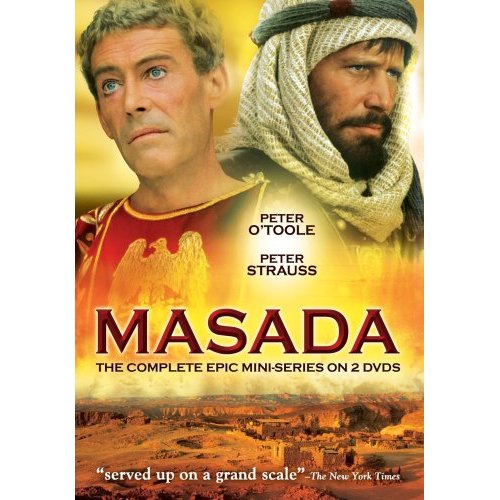
The inspiration behind this is twofold.  Firstly the mini-series (remember when these were all the rage?)  Masada; which I probably saw when I was about fourteen.


For some reason I sided with the Jews, I can well imagine, not having seen the series in over twenty years, that it was written so I'd have too.  As I recall the acting and setting was top notch, and clearly it stuck with me.

Secondly, as part of my reading of the classics, I plodded through Josephus a few years back:


One of the telling aspects of the book is just how quarrelsome the various Jewish sects were, it's a wonder they ever organised a rebellion as they seemed to be as ready to fight one another over whose version of the Torah, or command style, or hat was best.  Nevertheless Josephus (who was a one time commander for the Jews, who switched sides and then wrote a history of the war) highlights a number of Jewish victories and aside from the extensive politicking, does go in to considerable detail on the Jewish battle tactics, and campaigning.

So, the background is set, but I needed to get hold of models for the force.  Not wanting to spend an arm and a leg on models that anyway don't appear to exist in metal, I decided on converting the huge variety of 28mm plastics out there.  My previous army was a mix of mainly Hat, Italieri and Zvezda plastics in 20mm:


Now subsequently sold to a chap in New Zealand.

Knowing the variety of models available, I knew nothing was a perfect match, but decided that the ever useful Wargames Factory Numidians would be the base for most of the models.  I decided to blend these with an initial batch of Warlord Games Roman Auxilaries, as it appears from the account that captured equipment was a major part of the inventory of the Jews.  However the signatory feature of the Jewish troops appears to be the Mantle - cloak-like covering common to all levels of society.  Whether it was practical to wear in battle is an issue I've discarded (I suspect it may not be) in favour of modelling it, so as to make the rebels look suitable Jewish.


As is self evident, these were made from Greenstuff, procured at £6.50 a metre from eBay.  Actually my first time using the material, and much easier to work than Milliput it is too, though not as strong.  For this unit I tried out a variety of ways of doing the cloak before settling on a style I liked.  The last handful had clasps added too.

Satisfied with that I test fit the unit to it's bases:


Initially I'll be doing units of four stands with a 120mm effective frontage.  20 figures to a unit.  Dropping one figure per base from what would be typical allows me to both economise on numbers a little without losing too much impact, and to make the bases look more disordered; as the Jews should be something of a rabble.  Overall they take up all the space anyway, not being in particularly unified poses.  I think the net effect should be pretty good.

So now it's on to the painting...

Wednesday, March 14, 2012

Napoleon's Army

Pen and Sword produce no end of military history tomes, exclusively reissues so far as I know.  You can pick them up easily enough at wargame shows and online for a relative pittance, and despite the age of some of the writing they are generally fascinating reads.


I picked up the above late last year for all of a fiver; and it was well worth the investment.  Rather less so for the initial chapters on the Cavalry and Infantry; subjects that are enthusiastically covered in most books, but more for the discussion of logistics and command systems, which effectively Mr Rogers spends half of the 190 odd pages covering.

At the end of the tome Rogers discusses the Prussian and Polish campaigns of III Corps 1806-07 in detail, concentrating on the operational procedures more than the major battles, and paying particular attention to how special operations were conducted - several of the minor engagements detailed would make excellent wargame scenarios.  As an epilogue, he details the personal experiences in the 1814 campaign of one cavalry officer within the guard, both to highlight the difficulties of rebuilding the destroyed armies after Russia, and again to scrutinise the flexible tactical operations of the French armies in the field.

It is not a campaign history, but it is far more revealing as to how Napoleon went to war, and how his armies evolved over time.  A very rewarding read for the enthusiast.

Sunday, March 11, 2012

The Persian Expedition

I recently finished reading this; I find I manage one or two classic histories every year.


The book is of course, as you must all know, Xenophon's personal account of his experience as part of Prince Cyrus' attempt on the throne of the Persian Empire.  The book is often known as the Ten Thousand, for the number of Greek troops involved.  Xenophon's history has been criticised for potentially over egging his involvement in the campaign to extricate the Greeks from their predicament after the Battle of Cunaxa; but I felt that in any considered reading of the volume the fact that Xenophon was not in sole command was clear enough.  Of course he writes himself well, that is the nature of a personal account, and clearly he did have the odd axe to grind.  But I think in the context these can be overlooked.

Taking the time to read the introduction rather than just diving in will reward you, but for the wargamer the details of Greek military tactics, and the accounts of numerous small and large engagements are the items that will appeal; and will probably result in a number of bookmarked passages.

Overall, it's easy to see why this is seen as a favourite read for schoolboys of a certain generation (presumably the generation that wore well pressed shorts and learnt Latin still, the age of the George Cawkwell - who wrote the introduction - would suggest he has in mind the 1950's, or earlier still!).  Unlike many history books it is not dry, and positively jogs along with plenty of action and the odd stirring (surprisingly well 'recalled') speech.

If you fancy taking your warring Greeks to face the Persians, Thracians or other assembled tribal masses on the their own turf, or have more than just a passing interest in classical history; this really should be on your reading list.

Monday, October 24, 2011

Kampfgruppe Normandy

Spurred by their present sale and the opportunity I had to look at a copy of the rules a week or so ago, I succumbed to buying a copy of the Warhammer Historical World War Two rules.


Now, had I not had any chance to look at the rules before I would have presumed them to simply be another reworking of the Warhammer 40k game engine, as used for The Great War rules.  I've dabbled with Warhammer World War two in the past, and whilst they worked adequately, they were not especially distinct or innovative.  I would have passed on a £24 version of them (never mind a £48 version!)

But I can happily report that these rules are nothing of the sort. Although based on a purely D6 system, it is far more thought out than Warhammer and contains a number of features to reflect the fog of war and the reality of battle at a relatively small scale.

The rules are for combined actions in the Normandy theatre specifically, dealing typically with engagements of platoon to company scales, though for those with the time and space, Battalion scaled battles can be accommodated.  It is early, and I haven't yet read the rules in full, or played them, but items I like based on first reviewing include:

  • Although the rules are IgoUgo, a player can set up his units to interrupt the opponent's turn.
  • You can only activate as many elements of your force per turn as you get randomised command points for, plus the value of command assets you've purchased for your order of battle.
  • You can always fire for suppression at a target, but aimed fire requires observation.
  • Hitting a target is much the same for any firer at a given range, it is down to the concealment of an enemy as to how effective those hits are.  Units running around under the enemies guns, in the open, will get slaughtered by fire.
  • Similarly anti tank fire is effected very clearly by armour.  If a tank's armour is too thick and the firers gun too weak, there is no chance of destroying the target, though on a double six you do get lucky and immobilise it.
  • Suppression stops units acting until the commander uses morale chips to remove them.
  • Artillery cover can be dedicated or limited, so there is no guarantee of getting it when you need it.
  • Air cover is even less certain.
  • Several actions require the use of morale chips, and when you use a morale chip it reduces your overall morale by a random value.  Your force morale is based on mainline units in your order of battle.  Run out of morale points and your force is broken and the game ends.
In short I like a lot of the core mechanics and they are nothing like 40k!

Also they are only the first quarter of a 360 page, full colour rule book.  Also included are 8 army lists (4  German and two each for the Americans and British), 2 campaigns, a tonne of background and no end of scenarios.  Given the production values, one can see why the book was priced originally at the astronomical price of nigh on fifty quid; but at half that it represents a veritable bargain!

The rules talk throughout about 20mm scale gaming, my first love, and lean towards, but don't depend on single based miniatures.  I think those with flames of war armies would have no difficulty using these rules instead, though I feel the game will be slower and more realistic by comparison.  Additionally small games with 28mm models will probably work well enough.

Given the apparent situation at Warhammer Historical/Forgeworld*, I wonder what future these rules really have, but if they play as well as they look I'm sure internet support will develop for them.  Hopefully other theatres will be covered in the event of such success.

I certainly look forward to giving them a try, and if nothing else they are a rich seam of material to mine for any WW2 gamer.


*Incidentally, indicative of FW's mindset, and part of the problem with my copy of a historical set of rules, I received catalogues for their ranges of resin models for GW's premier fantasy and Sci-Fi gaming systems.  No use to me, or many other of the buyers of these rules I think, and straight into the recycling.  FW does not seem to understand its new subsidiaries audience and so is wasting money marketing wrongly at them.  Yes, they have nothing to offer that audience, making no historical models; better to say nothing at all therefore than to annoy your customers with 'junk mail'.

Thursday, August 18, 2011

The Last Argument of Kings - Preview

It's not really one of my periods,  but I did get shown the first supplement for Black Powder yesterday.


Against general expectations it covers the 18th century, rather than pushing back the core rules to the 17th as had been suspected.  The style is very like the original rules, particularly the example battles section, though additional special rules and details on commanders are also included.

The book covers all of the major engagements, and a few more minor (if popular) ones, including the War of the Spanish Succession, the Austrian Succession, The Great Northern War, the Jacobite Rebellion and the colonial wars in India.  They stop at about 1775.

The book also includes army lists of a sort, that is to say they allow you to put a realistic balance of commanders to a realistic proportion of units.  Points values remained notable by their absence*.  Lastly, for each period a sample battle is included.

112 pages in full colour for £18; if you are a fan of the rules and this period, it seems like excellent value.


*Hoorah!

Sunday, October 17, 2010

All for a Shilling a Day

An early book, now something of a classic, by the (still very much alive apparently!) Donald Featherstone; one of our hobbies true forefathers and leaders.

'Shilling' tells the tale of the 16th Lancers and the battle of Aliwal in the first Sikh War. In particular, Donald focuses on the recruitment, training and living conditions of the troopers in an unromantic style.


Oddly, what was I reminded of when reading this? Warhammer 40k. The grim past of which Mr Featherstone speaks precedes and carries a similar tone to the endless savage backstory within Games Workshop's dark universe.

Safe to say death and misery are never far away from the troopers of the 16th, even if they are far from battle. In fact battle is their time to shine, and is represented as far preferable and as the epitomy of Victorian endeavour.

Donald's knowledge of the subject is extensive, this book was originally published in the 1960's, but at this time I think his writing was still under development. The extensive notes (well over a third of the book) are excellent, but at times his efforts at carrying a semi fictionalised narrative, and some limited dialogue are laboured and repetitive. Some of it today is some distance from the politically correct. Still it speeds along, and as a rainy Sunday read will bring out the small boy in any wargamer over the age of forty.

It is regularly republished and last appeared in 2007; you should have no difficulty finding a copy, and it will be worth while.

Tuesday, October 13, 2009

Napoleon - A few words


Well, there is a swing in my club towards these as a set of playable rules for Napoleonics, and so I picked up a copy.
Despite a hefty page count of 223 pages I managed to read through them over the week and with the caveat that I haven't actually played them as yet, I can offer a few thoughts.

Presentation: High production values still can't hide a fistful of minor typos. Ordinarily in a book these wouldn't be more than mildly diverting; but in wargame rules a point that is stated once as one set of values, and later repeated with different values is the chink in the armour that beardy players use to dig in and exploit a game. Similarly an obvious error in writing that clearly contradicts the intention of the rules will allow the 'Rules as Written' crowd to exploit an advantage. There is little of this in the book, but it shouldn't have been there at all. I spotted it on one reading in a week; did they not have time in their production schedule to put in a week for proof reading then?


Another point is that any close inspection of the photographs will show that there were actually little more than a handful of display setups of games made for photography. All the images of sample units in the army lists are photoshopped, and virtually none of the bases shown appear to exist in reality. In the group shots, 90% of the figures are based to different conventions than those recommended in the rules. So that is clearly an area of complete irrelevance to play!


Rules: You might think I'd start here, but I'd be surprised if unlike me you didn't spend your first hour just pouring through the book; taking in the above.


The rules themselves are short, simple and elegant, relying on a command card system, once forces close to a range where they could charge each other, to control the battle. It has to be said that one initial concern is that it seems likely that units will often fail command rolls, which are they key governor of action, and so stand around doing nothing an awful lot; regional commanders influence is limited, and unless you are French or blessed with good commanders your chances of operating will hover around the 50/50 mark when in range of the enemy. Not having seen this in action I may be unduly concerned, but the math suggests a possible excess of randomness here.


Another displeasing randomness is the rolling for Generals abilities at the start of the game. This means you could find your command system blessed with geniuses or hamstrung by halfwits. There is no point system to allow for buying generals of a given talent; which I would have preferred so you are stuck with this as it stands. Knowing my luck the dice will favour me with the occupants of St. Dunstan's school for the In-bred Nobility whenever my British take the field.


That aside the forces move freely outside of contact, but once in the 'engagement range' it is down to the cards; offering a variety of expected aggressive and defensive options.


The Firing and combat is all d6's and much what you'd expect, though some of the ranges seem longer than rules like this typically go for, they are not unreasonable, (IIRC) muskets fire up to 15 inches for example. What is nice however is that there is no casualty removal. I approve of this.


If you look at casualty rates in smaller general engagements, where one regiment can be seen to act upon another, fatalities and wounds from battle are never as bloody as most wargames rules would imply. However the morale effect of attritional loses is seldom handled well. In both these aspects it looks to me like the rules get things right; units at least appear at full strength until destroyed; which will almost always be as a result of routing from the table, and the effect of casualties on the morale of the unit is to my mind believable - there will always come a point where no matter how good the unit, it's position on the battlefield will become untenable.


Rules for terrain, weather, skirmishers, engineers and so on are included, but none of this causes the rules to stretch much beyond 80 generally well laid out and clearly explained pages.


Scale: Obviously intended for 28mm, the only games in action I've seen have been played in 15mm by halving all the stated sizes. Units are notionally formed of six bases of 4 figures for foot troops, on 40x40mm bases. Now this matches almost no-ones established collections, though it is becoming more of a standard with newer collectors.


I must point out that the stated unit sizes are, due to the game mechanics, almost totally irrelevant. You have the same game with units of four bases of 6 figures as with 6 of 4. You have the same game if one side is on 60x20mm and the other on 45x40mm. So long as the number of figures in the unit is roughly the 24 suggested, and the footprint of similar units in armies are about the same, the game will play as intended.


You can virtually ignore their recommendations, as I said in most of their own photo's it's obvious they would.


Incidentally the game is written with 4 feet wide tables in mind, This allows little space for manoeuvre, but a 5 or 6 foot wide table with both sides starting further apart would easily remedy this.

Army Lists: The next major section; and a bit of a mixed feast. Some armies are covered in great depth, notably:
  • France: including most fronts from 1805-14
  • Britain: for the Peninsular campaigns
  • Austria: for the period 1805-14
  • Prussia: for the same period
  • Russia: for the same period, with additional rules for the 1812 campaign

Others, and I think anyone who even vaguely knows the period can spot at least one, are not covered at all. Many minor armies, and some major ones are not covered at all either; so no list for the Spanish, Italians, Swedes, Minor German states (except Bavaria, covered under a French list), Poles, Turks, Egyptians, etc...


This is where the fact that the rules are specifically supporting Foundry's own range of models becomes abundantly clear. If they don't make models for it they haven't included it in the rules. That is highly annoying, but in this day and age unsurprising. Hopefully they'll have the decency to release a supplemental set at some point; otherwise enthusiasts will soon clutter the net with amendments and additions.


Background and supporting detail: Mainly as part of the army lists there is a fair deal of supporting material; the rules will serve as a good uniform guide for the basics of the covered forces; and history of the campaigns are given in brief. Still it can only be little more than an introduction. There are two painting guides, one is the super detail option few of us can expect to achieve for more than a couple of models a month, and is just as much a huge plug for the Foundry paint range, the other is full of good practical advice for getting units churned out effectively, if not so prettily. I think the latter is the more useful.


So overall. There is a lot to like, but it could have benefited from a little more time and a little less of an 'in-house production feel'. With Black Powder on the horizon and no shortage of established rules out there with their own adherents, you have to wonder if Napoleon will be a long term success. But in the rules themselves, I think, and I cannot confirm it yet, that Matthew Fletcher has come up with the goods, neither off-puttingly complex, nor childishly simple.

Tuesday, October 06, 2009

'Chariot' - Book Review time


Arthur Cotterell has an awful lot of interesting material in his book on the ‘rise and fall of the worlds first war machine’. Perhaps as a consequence, it often feels incoherent, and there are frequent situations where he seems to favour mythology over archaeological evidence or historical records.

The book looks at the broad sweep of use of the chariot, focusing on four main areas, the near east, India, China and Asia Minor. The problem is that Cotterell’s evidence is frequently drawn from limited or mythologized sources, which he relies on too much. Also he has fixed in his mind his own clear timeline, which means he has to dismiss the use of Chariots for practical military action once cavalry are introduced. He instead reduces it to ceremonial and sporting use.

This despite the fact that Chariots were active weapons of war in Celtic Europe for centuries after that date, despite the fact that the chariot was still used in great numbers, if not as the elite super weapon of days past, in the near east for a good 600 years after the introduction of horsemen.

It is also clear, despite his excellent points on the use of chariot archery, that Arthur is not a specialist in military history; for example he doesn’t appear to know about box saddles and therefore can’t conceive of effective heavy cavalry until the introduction of stirrups; so never mind what the Sarmatians were doing for example. Also he dismisses the idea of chariots as mobile transport, yet we know Julius Caesar himself fought against chariots used in just this way to great effect. There are other points too.

But perhaps the biggest problem is the scattergun approach of writing. Poor old Arthur has so much interesting material that he cannot seem to keep his mind on one topic for very long. Is the obsession with physical perfection in Indian kings really relevant to chariot warfare? Failing that you suddenly find yourself in the midst of another subject, probably mythical, when the paragraph started by discussion arrow heads.

This is a harsh review, because as a book on military history, 'Chariot' fails. Nonetheless, there is some interesting material here, but it is not nearly as revealing as I would have hoped.

Saturday, September 12, 2009

Book Review: The Lion & The Union

A lucky find in my local library is one of the few in depth studies on the history of the little known Anglo-American war of 1812-1815. A war which is mainly known just for the burning of the White House, and the writing of 'The Star Spangled Banner', a war that had one of its' largest land battles after the peace treaties had been signed for many weeks.

From the wargamers standpoint the book is a mixed feast, Kate is very readable, but nonetheless spends the first half of the book - some 140 pages - dealing with the political context and run up to the war. Once she gets on to the matter of the war though it certainly holds the attention and throws up all manner of interesting skirmishes and small scale actions for the wargamer to try to represent. For example attacks across the frozen St Lawrence with artillery mounted on sleighs! However, there are few maps, which makes following the spatial details difficult, and the native American aspect is covered very thinly.

Perhaps the biggest problem is the simple one of keeping track of the many characters and which side they are on. Some of the rival commanders held office for fairly short periods, and of course there is little to distinguish and American name from a British one. Nevertheless, this is a worthwhile read, and one which should be in the collection of anyone with an interest in the war.

Sifting through the material will give you details of dozens of engagements, unit sizes and organisation (for example, locally raised Canadian light companies numbered 41 men), and the odd uniform detail too.

Published in 1978, expect to find this only on reputable book selling sites like Abebooks.co.uk or in your local second hand specialists.

Friday, August 28, 2009

Introductions in book form

A few entries ago I talked about Battle! By Charles Grant. This set the ball rolling on a brief and very successful hunt for the other book I mentioned, ‘Introduction to Battle Gaming’ by Terence Wise. For a surprisingly small price I managed to get hold of a copy via the second hand options on Amazon. Whilst in the same time frame a judicious use of library catalogues allowed me to get hold of two other comparative books: Donald Featherstone’s ‘War Games’, from 1962 and ‘Wargaming, An Introduction’ by Neil Thomas, and released in 2005. Consider this entry a review by comparison of all three.


How does the Terry Wise book compare to my memories of it as a child? I reckon I probably borrowed this from the library only two or three times as a nipper; yet regardless of that I suspect I read it cover to cover a dozen times. On getting hold of my very own copy I did exactly the same again, reading it from cover to cover in an afternoon.


The photos are even more evocative, with a homespun charm that is common to all of the wargames books of the sixties and seventies. As is some of the advice. I remember making my own papier-mâché hills by exactly the fashion Terry shows; whilst buying the same Merit trees he recommended – somewhere they are still in a box of terrain of mine.


Like all books of this type it is centred around a mix of telling readers a little history, advising them on how to collect their army/armies, and of course some simple rules, with examples typified as what we would now call battle reports.

Of course back then figures choices were remarkably limited. A few metal ranges were available, but Terry pretty much exclusively used Airfix figures for the book, managing to convert entire ancient armies out of a mixture of practically every pre-gunpowder set they made. The historical accuracy is to modern eyes laughably absent, but it was early days.


On this front Terry was in a rich position compared to Don’s book; he made his German tanks from Plaster of Paris as no models of them were available! How lucky we are nowadays to be able to buy pre-made resin models of every tank involved in WW2 or metal or plastic miniatures in whatever scale we fancy of any army imaginable. Instead we spend vastly more time on terrain, and painting, something that neither book shows quite the same demand for.


By Neil Thomas’ book, visuals are far more important, the images in the well presented volume are lifted from Miniature Wargames and show many hundreds of well painted figures on attractive terrain in a variety of scales. And as was a feature of MW at the time, a little light photo-shopping has added to the gloss of many of the images.


Then of course the rules are there. Each of the three books contains basic rules for the chosen periods. I have to be honest, Terry’s rules are not great; deliberately simple, being aimed at children, they now seem terribly crude, at the original reading I had little but a passing interest in the Ancient gaming, and none at all in the horse and musket rules presented, but I did try his ‘Modern’ rules, and they only lasted until I read Charles Grant’s ‘Battle!’; a much superior set.


By comparison ‘War Games’ contains rules by Tony Bath for ancient periods, which have several good features, more complex but superior to ‘Battle Gaming’, and still simpler than most modern rules. In passing, I’d say many of their features seem to have evolved in to Warhammer. The book also contains Lionel Tarr’s seminal rules for WW2 gaming, often spoke of glowingly by old-school gamers; and again, short but effective they are. The thing with all of these rules of course being that they will not stand up to brutal points based competitive gaming, and certainly leave a lot of room for interpretation if unexpected things happen.


Thomas’ book too contains rules, simple, effective ones for six different periods; with the added innovation of army lists allowing fairly equal games.


Over the years the format of these books has not changed then, but what one can say is that the frequency of them has. Back in the sixties and seventies, these books appeared annually, and were, can you credit it, reviewed in mainstream literary press – ‘War Games’ was reviewed by the Daily Telegraph, in the way I suppose that a modern Sunday supplement might review a PC battle simulation! Thomas’ book by contrast is probably the first of its’ type for over ten, maybe fifteen years.

The world has moved on, wargaming is one of those hobbies that has gained a new lease of life on the internet; but such changes mean less demand for the simple pleasures of a cup of tea and a good book.


Not that the passing of simple rules and games based on ideas rather than points values has occurred though, and I’m pleased to see groups of old school wargamers faring well enough, even if they tend to be of an older generation.

Any of the books mentioned are worth a read, but to be honest, unless you’ve been gaming for at least twenty years already, you’ll probably be happier with Thomas’ book. All three are intended for beginners; Neil at least has the advantages of glossy production and the wisdom of those who went before him.


Sunday, August 16, 2009

Battle!


This was the second wargames book I ever read.


I was all of eight or nine years old, it was the late seventies, a time when wargaming books were still in libraries; I was an avid reader, and for my age a prodigious one too. I'd quickly discovered that children's stories didn't interest me much, I preferred history books, tales of war, foreign countries and aliens. Browsing the shelves I came across a copy of 'Introduction to Battle Gaming' by Terence Wise one day, and so ended up as the sad gaming geek I am today.

By my next visit to the library, I had a box of Matchbox Commando's, and was saving for their set of Afrika Korps (no logic to those choices beyond which looked best!). Sticks, pellet firing cannons and 1/32nd scale toys had been replaced by the d6 in all my unwanted board games and the local model shop.

On that next trip to the library, I found a copy of 'Battle' where the other book had been before. Naturally I took it out and started to use it; not just reading it, pouring over the photo's obsessively, reading and visualising the engagements that Charles Grant described, and hoping one day (after a Christmas no doubt, or during some long summer holiday) to emulate them.

Of course I was still only eight, and I'm pretty sure that only the basis of the rules made any sense to me at the time. Also I didn't get to hang on to the book for more than three weeks. So I set about scribbling down the bits I needed in a brown scrap book, and they went on to serve me well for the next few years of playing on the spare bedroom floor.

Fast forward thirty years.

I found an account of a game played with these very rules in the Battlegames TableTop Teasers book, written By Charles S Grant, Son of the late Charles. Now that sparked some memories. And so, good old eBay eventually provided a copy of my very own.

And do you know what, their actually a pretty good set of rules.

Alright, they don't contain a lot of the finesse that newer sets do, but there was an expectation at the time that if you yourself didn't fight in World War 2, and have some idea about how thing worked, someone in your family would be able to inform you. Such was the world back then, when these rules were written the war was only as long ago as the Falklands War is from us Brits today (foreign readers insert your own relevant event from the mid eighties as you wish). So far as rules go Mr Grant had a lot of things simply but effectively covered, given the intention to cover company sized actions with artillery and armoured support it's all very workable.

Simultaneous movement, an easy firing system, integrated communications, a reasonable morale system; it's all there. Of course a mixture of reasons must be behind the assemblage of forces in the book; Mr Grant's Russian infantry attack the Germans in the classic 'Action at Twin Farms' from the back of a platoon of German half tracks, and every side has access to an unlimited supply of Willy's Jeeps for transport. At the time it was written the only decent suppliers of military models in a suitable scale were Minitanks and Airfix; neither range even close to the completeness we are familiar with today.

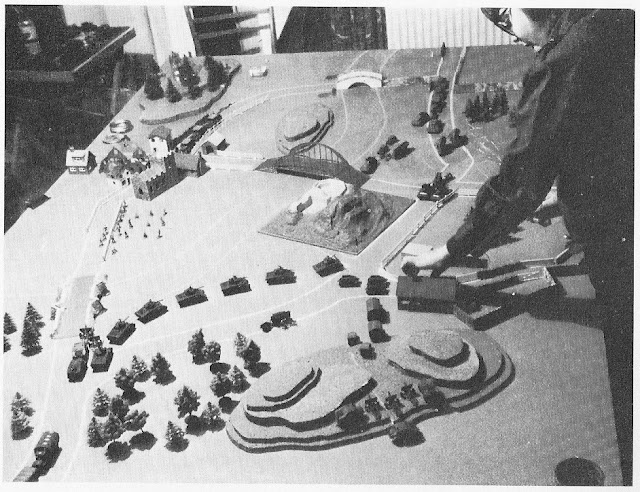
But ultimately it's the nostalgia that really wins my heart with this one. The text is simple, and clear, and if a little patchy in the sort of all encompassing detail gamers expect nowadays, remains usable and evocative. The write ups of battles used as instruction on the rules fill in the details of a narrative account. And the numerous (if sometimes rather indistinct) photographs, look more authentic than many modern shots of over cluttered games, with too many models crammed into the space and counters everywhere (Flames of War, I'm looking at you here!)
If you have the good fortune to come across this book, I urge you to grab it; it'll take less than a day to read, and whilst you may never decide to use the rules themselves (a mistake I'd say), it is a real reward and a joy to read; to see part of where our hobby came from, and I'm sure for many of us from before the Games Workshop era, a chance to return to our youth.

Friday, January 23, 2009

Quick updates

So, I've been terribly lax in not posting lately; the snow has only just got good again, though today outside my chalet it is raining hard. The main reason for not posting however has been a lack of the internet for three weeks in the chalet; now fixed.


The associate excuse for not painting has been three concurrent weeks of colds which only felt ok when out on the hill, not when sat in my tiny bedroom faced with paints.


In fact I have made a start on nine ACW infantry, doing an acceptable job of their coats and trousers. That done there is little left to paint so another hour or two could see them finished. It's an aim for the rest of the day.
Otherwise I've been reading "Remember Nelson; the Life of Sir William Hoste" by Tom Pocock. Hoste was one of those naval commanders who inspired the many fictional naval characters. He managed many remarkable feats in his career including winning fleet actions against bigger odds and successfully beseiging 'impregnable' cities.

It's pretty well written and thoroughly researched, and for the three quid my copy cost, well worth a read if you like action under sail.

Saturday, December 27, 2008

Two books, two points of view.

So I hope we all had an excellent Xmas; in the run up to the arbitarilly assigned date of significance I found myself reading 'Achtung Scweinehund', by Harry Pearson. An excellent little book.

Harry like so many of us, grew up in an England not so much haunted by the Second world War, as infused with it; and the influence it has had on his later life is a large part of the subject matter of this book. He manages to warmly recollect his childhood with toy soldiers, the hopeless Action Man and the interminable Colditz boardgame; whilst Uncles told him about how many 'Japs' they'd killed in the war. At the same time he does a good job of introducing wargaming as a subject for the uninformed, and of providing a basic history of it's genesis in Europe (particualarly from around 1600 onwards) and the early manufacturers of the figures with whom he is most interested.
Also, and importantly, Harry addresses the emotional issues related to wargaming, and more generally that certain breed of men who seem to enjoy them most. Towards the end of the book he considers the issues of Nerds, and the many breeds of gamer. How some of them seem never to grow up, whilst others drift away from their hobbies as some sort of social expectation makes them believe the time or money invested is not worthwhile. For Harry himself, he is proud to admit he is a Geek, and by the end of the book has reconciled the position.
The distinctions between Pearson's book and another I read earlier in the year, could not be more distinct. Whereas 'Achtung' celebrates a hobby, 'The Elfish Gene' reads like an embarrasing condemnation of one, with the 20/20 vision of hindsight in very tight focus.


As a roleplayer in my youth, I can identify with an awful lot of the experience Mark Barrowcliffe writes about in his book, just as I could with Harry Pearson. However, whilst Mark's book is on face value much funnier, you rapidly come to realise that this is because he is deeply ashamed of his involvement with the hobby. The guy is painfully aware of how uncool he feels his hobby made him, and blames in large part the hobby for making him that way, rather than the tendency of all boys to be like that.
As a result, there is a denialist streak running through 'Elfish', as if the author is very definately saying 'what I did was wrong, and I know now that it was wrong; please forgive me and don't do what I did.' He paints the characters who were involved in gaming as almost uniformly dysfunctional in some way, and potrays his ability to talk to girls as a sign of his superiority over them, and gateway to final freedom from geekdom. Frankly this is kind of annoying, and what is worse is that Mark simply chooses to attack his target, as it would be seen as an easy one to do so with. I can't imagine a similar version being written about Football or Fishing for example.
For all of that, it is a humourous red, but unlike 'Achtung Schweinehund, it leaves a bad taste in the mouth. For a nostalgic and ultimately nourishing read, use your Xmas book token on Harry Pearsons work; then lend it to friends or family who don't get why you like toy soldiers. Borrow the elfish Gene from the Library, by all means; but don't attempt to explain yourself to anyone with it!


Thursday, November 13, 2008

Boardgame all-dayer

The recent theme of board games was strong again in the club for me and this last Sunday I also took along my Pirates cards, occupying as they do a middle ground between a conventional wargame and a boardgame. We rattled through a couple of games in under a hour each, fairly standard fare, but it introduced two guys to the system, and as is so often the case, caused a number of people to wander up and declare they had a pile of these in a box under the bed somewhere at home.

Of course I failed to win either game, in the first two-hander I was sunk in close action whilst trying to make off with the enemy's ships. In the second game three of us fought over the islands.

Again, the author wisely hides himself behind the lens
On reflection, this is possibly the weakest way to play the game, as it conveniently divides up the basic layout to 'one home island and one wild island' each. The treasure placement means most of the time the island nearest a player will have their best treasures and the opponents worst treasures. Players will ferry their treasure home unassailed, and the game will turn on the luck of who had the best hand of second-choice treasures dealt to them.
In this game fast ships will always win, and indeed the ability of one player to nick a couple of bits of treasure off my island won it; although knowing I was going to lose, I made merry hell with a massive five-sailed ship, blasting everything out the water foolish enough to get in my way.
Next time I think we'll go for a 'fleet action' and start with the treasure on our vessels instead.
After this we played Condottiere, essentially a card game with a board for recording the results of hands. The idea is each player represents an Italian prince and uses his hand to try and gain control of territories. It's a game of bluff in essence, and I did appallingly at it, not coming close to winning either time. We squeezed in a game of Dominion next, before moving on to Battlelore.
Battlelore is essentially a hex based wargame, with simple unit representation and a command and control system based on the use of cards to activate units in one or more of the three sectors of the battlefield.

It's the sort of game that will certainly appeal to people who like the idea of wargaming, but not the investment in time involved in painting figures, making terrain and so forth. I found it a little simplistic, but competent enough, and the little figures (approximately 18mm scale, or 'true' 20mm - 1/87th) are nicely made and begging for a paint job. The rules covered both historical and fantasy games, and provided figures for both - Humans, Goblins and Dwarves; which I could only approve of, though if you are not well versed on your medieval history already, you are only likely to recognise one battle.

As it was we 'proved' that the English couldn't win Agincourt; twice!, before 'refighting' a thirteenth century battle from of succession in Brittany. The historicity of the result will remain in doubt, though clearly in the Agincourt scenario, the designers had opted for game balance over reenactment.

All in all another entertaining waste of a day!

Wednesday, November 05, 2008

Of boardgames

The Leeds NightOwls have a steady attendance of boardgamers, however until recently I'd not got involved in any games of such.

Although I enjoy boardgaming, and have a selection myself in storage, they always play second fiddle to moving figures around. However when you are burned out on being cheesed to defeat/cheesing victory every week in Warhammer, and can't seem to get a game of 'proper historicals' going, the opportunity to play a game where the rules are the same every time and for all-comers is appealing.

First up for me was Space Hulk, a game I played once about 15 years ago, but fondly remembered. To say it is a blatant rip-off of certain science fiction films is somewhat baside the point; in a simple game engine it rather brilliantly captures the tension of said film, and with its' map styled board has potentially infinite variety to otherwise simple game play.

I played The marines (neither of those guys are me by the way, wisely, I'm behind the camera), attempting to reach a room in need of a serious burning. As was the nature of the game, this all went very well until the first casualty. Thereafter the managing of troops becomes increasingly difficult; until it reaches a point of impossibility. Winning as the Marines seems to be very hard, despite the fact that they pack vastly more firepower than the attacking Aliens, erm Genestealers.

Overall, Space Hulk falls into the category of 'Simulation' for me, in this case a skirmish/tactical military sim. The other game I've played, and really enjoyed, recently is at the opposite end of the spectrum, being pretty much completely abstract.

Dominion, is played solely with a deck of cards, no dice, no board, no counters. In some respects it is like a Collectible Card Game, though the set itself comprises all the cards available, and there is no requirement to buy other items. Each player represents a petty lord aiming to create the largest kingdom, and this is expressed through the accumulation of a deck of cards.

Each player begins with ten identical cards from which a hand of five is drawn, these comprise money and lands, lands equal victory points, but play no part in the active game, other than clogging up your deck. However to buy land you need money, with which you can also invest in buildings, communities, warriors, events or characters. In game ten different types of 'action' cards are available to buy and these influence what you may be able to do in a turn.

For example, during the turn you may find a hand thus:

Village
Witch
Gold (value 3)
Copper (Value 1)
Duchy (land)

You start a turn with an action card - so you may play the village, which allows you another card and two more actions, you might then play the witch - another action card that attacks other players. Then having, used your action cards you may use the cash in your hand to buy new items, with 4 money you might want to get a workshop for example. You then draw a new hand of five cards, and reshuffle all your other cards, including the ones you played and your old hand.

It is really, beautifully simple.

The play takes the form of an acquisition race therefore, whilst some cards will hold up you opponents, the main aim is to rush forward your own strategy. Any given hand is random and essentially dictates it's own play order, but the subtlety comes in how you use you resources to load your deck. At first you will concentrate on action cards, then money and finally lands. The game ends when three piles are expended (out of the sixteen in play).

The other beauty of this is that you can only guess who is winning, based on what you recall them buying, stealing or otherwise. When the game ends the values of lands and limited other special cards are totted up, highest result is the biggest dominion.

It's a totally abstract game, but in the two games of it I played, we were quickly into the character of our preferred tactics, and the sense of rivalry was amiable, but genuine. It's a game simple enough for kids to learn, but clever enough to reward multiple plays.

Also the cards themselves are attractive, and of high quality, but you'll soon want a nice soft surface to play on. All in all though, very enjoyable.

In the next couple of weeks it may be more boardgames as the figures go back to storage, so it's nice to know a few good ones are around.