Showing posts with label Game reviews. Show all posts

Sunday, March 10, 2019

Rebels and Patriots: The TML Review

Okay, so it's a big day at TML towers, as I've played the latest iteration of the 'Rampant' game engine, Michael Leck's (with Dan Mersey) 'Rebels and Patriots'.


The hot take, R&P takes the Rampant Engine and makes it work for the 18th & 19th century, it also fixes many of the things that people who disliked the previous iterations hated, but it naturally lacks the sheer variety of the Fantasy version.

Rebels and Patriots is a set of rules for black powder warfare in North America, roughly the period 1750-1870.  Like all the Osprey rule systems, R&P is pretty short, and like the various iterations of 'Rampant' before it, rather straightforward.  The battle rules themselves run to only 16 pages of the 64 in the book, but this is to discount the various key elements of the game subsumed to the officer, unit and scenario rules.

For those unfamiliar with the previous versions of these rules, they run at a large skirmish scale, without detail to an individual soldier level, except for the commander, but with units being in groups of 6, 12 or 18 men.  It is an Igo-Ugo system of alternate turns, everything is measured in inches, and everything in D6's with units generally rolling fixed numbers of dice regardless of individual losses.  If this sounds overly simplistic, do not fear, there is enough nuance to the rules to make it interesting.

Units are activated individually, requiring a modified roll of 6+ on 2D6 to carry out the desired action, which include moving, firing, Skirmishing, Attacking (engaging in melee), and rallying.  Disorder, caused by casualties and other negative situations.  If a unit fails to activate - unlike previous versions - you move on to another unit until all have received an order to attempt.  Leck, clearly believes the 18th & 19th century soldier was better drilled than his medieval forefathers.

All forms of combat boil down typically to rolling 12 or 6 (occasionally 3) D6, typically needing 5's or 6's to hit.  Two hits cause a casualty at short range and you add one to the number of hits required to modify for adverse factors.  In melee, both sides roll, and special reactions like evasion can apply.  Overall commanding troops on the table is easy and fluid, and handles the particularly American contexts of regular, militia and native forces operating together, well.

Morale is handled based on immediate losses from fire, not total accrued losses, therefore casualties could be seen as representative rather than literal, but the clever disorder mechanic is what really makes it tick.  A unit with one disorder token can continue to act but at some disadvantage, including essentially -1 to all rolls; a unit with two disorder tokens is considered Broken and is likely to retreat a lot until rallied; which is made harder thanks to the -2 to morale/rallying rolls this will apply.  On your third disorder token you rout and quit the field entirely.

The mechanics therefore are straightforward enough, units essentially operate as blobs, with 360 degree lines of sight, movement is simple enough and the commanders offer little initial benefit.  But the details really make the game.

You would expect troops of the period to be drilled, and so Close Order (an advanced version of the old 'Shield Wall' rule, in previous books) reflects this, troop types then go a long way to bring to life the period.  Line infantry may present dense walls of fire, Light infantry can utilise ground better, Shock infantry reflect Grenadiers with their improved aggression, and so on.  The rules also cover cavalry and artillery, and also - key to the region represented - native troops.  To do this it has stretched the core of the Rampant engine, but also made numerous changes (some may well say, accurately, improvements).  There is also some streamlining, but it works well.  This therefore allows room for a campaign system, based on the career of your commanding officer.

This has the potential, along with the scenario section of the book, to be almost universally useful, regardless of whether you play the rules themselves.  You create a commander very simply and they begin with 10 Honour and a personality trait - one of 36 available.  As you gather honour from engagements, your commander improves, or if you are unlucky, enters a reputational slump of epic proportions; but he will generally remain in command of your company, until death.

Honour is one of the drivers of the scenarios, and is a development of the old Glory/Boast system.  Gone is the lottery of assigning your own agenda to each battle and winning or losing based more on this than battlefield performance.  Now each scenario has fixed objectives, and victory goes to he who achieves these.  A pleasing 12 scenarios are offered (13 if you count, just beat each other up as a scenario).

The final section of the rules gives a range of example companies and the briefest precis of various engagements in North (and Central) America, from 1754 to 1871, all very useful, and as a player of the War of 1812, interesting to see.  But one obvious question would have to be, why only America?

Well, in essence the answer seems to be IP infringement.  Osprey's own!  As Osprey already have skirmish and mass battle rules covering this period for the European wars, Rebels and Patriots has had to keep to a tight subject to remain distinct.  But could it be used for other regions?

First of all one perhaps should interject by asking are they any good at all?  Well, in this writers opinion, yes they are.  As with every version of the 'Rampant' system they evolve and develop in positive ways, building on the best of previous versions.  At this stage I only have one actual play to go on, but that was most entertaining and they felt like they were a fair reflection of a general period feel.

So back to the previous point, are they any use if you are more interested in Simon Bolivar, or Richard Sharpe?  Absolutely.  There is nothing to stop the rules being turned to South American or European conflicts, and there is probably enough to permit some colonial wars to be reflected (though I imagine Mersey's 'The Men Who Would Be Kings' may cover that bent more than satisfactorily).

In conclusion then, I think Rebels and Patriots is a delightful little set of rules, and I expect I will personally get a lot of mileage out of them.  They appear well suited to their key periods of the American War of Independence and the American Civil war, whilst ably covering all in-between.  The rules are fast, simple and fun to play, with enough subtlety for a diverting and thoughtful evenings play.

Overall it's a strong approve here.

...


Monday, December 10, 2018

And here's another game I didn't get on with

Command and Colours, this is going to be mild heresy, especially for many historical boardgamers; but I don't like it.

And I say this despite owning a copy (admittedly unplayed, as part of the Art of Tactic/CnC Samurai dual system set from Zvezda).

I've played, the Richard Borg engine to the game in several forms in the past, but clearly hadn't recalled details of the experience, so when Paul at the club suggested a game of CnC: Napoleonics, I was happy to give it a go.  So we set up the Battle of Corunna for an evenings' diversion.

Starting deployments
Which raises issue one, a minor aesthetic one that may not concern all I admit, but, as a board game on hex based terrain at a very large effective scale; it doesn't look much like the battlefield from what I can recall of it.  It doesn't look much like the battle.  It feels overly simplified even.

A legitimate complaint for any representation you say, and that might be fair, but personally I wouldn't try to refight a battle where I couldn't do a fair representation of the ground, and units at a key level of engagement.  For me that is Regimental as a minimum, Battalion preferred for Napoleonics (which means I'm doing the smaller battles mainly); in this game I couldn't readily say what things represented, but at a guess, each block would be a Battalion?  Without 100% recall, I wouldn't know anyway, but if smaller than that, companies say, there's no way this represented the whole battlefield....
Opening advances
The next issue for me is, here is a system that tries to shoehorn an awful lot into an unmodified dice roll.  Well, how it gets round that is by modifying the number of dice you roll, but given you will usually roll between two and five dice, and almost always only be removing dice from the pool, this gets punitive very quickly.  An infantry advance onto troops in cover quickly finds itself incapable of doing any harm.  But elites soon become disproportionately strong too, as adding a dice in combat of shooting is a huge advantage.  Then the British at least had some implausibly large units (Guards of 5, rifle companies of 3 bases) leading one to wonder whether this was the only way to reflect quality in game, or a laboured belief that paper unit sizes ever existed in the field....

I digress, perhaps.

French high-water mark
The dice themselves, you have a one in three chance of scoring an effect in infantry engagements, but only 1 in 6 of a kill; in short causing losses is hard, but equally rogue rolls of several hits at once feel terribly unfair.  But these are only comparatively minor gripes.

The Brits win mainly by staying still.
The main problem, and it's a biggie, a game breaker, is the card system.  I just, HATE it.  The battlefield is divided into two flanks and a centre, and you can only move units in those sectors when you draw the appropriate cards to play such an order.  Now there are a few for each sector, and a few that play across multiple areas, but never enough.

Oh but isn't that just replicating the fog of war you say; I like that, you say.  Well, if it worked I might agree, but it doesn't.  Having no control over the composition of the deck, you can't lean into simple tactics in preference over complex but deadly strategies - as one might in a deckbuilder - you are stuck with what you get.  Moreover, you really are stuck with what you are dealt.  You can't discard and replace a duff hand, in the hope of getting what you need, you must just play them out one card at a time and hope for better.  You will almost certainly go several turns where the perfect move presents itself, and you can't do it, because NONE OF YOUR F******G CARDS LET YOU!  It's not representing a battle where one of your subordinate commanders is poor, it represents an engagement where all of your commanders are recalcitrant halfwits.  It's like playing Black Powder by ignoring the Orders system and relying on the Blunder table instead.

It's bollocks.

Clearly the reader will have gathered two things from this.  That I didn't win, and that I don't like the game system.  So, yeah, maybe the two are connected, but personally I don't see why winning would've changed my mind.  In many cases my opponent won simply because I was unable to make the right attack at the right time, not because they struck me in any devastating way; you can't seriously feel you won a game in that circumstance can you?  The system makes punch and counter-punch virtually a lottery.

The third point however, is simply that the game was not fun, and finally, it didn't feel much like a historical simulation either.

Really not for me.

I'll stick to miniatures on this one.

...


Wednesday, May 31, 2017

Board game Roundup - Vol IV

Lots of board games recently, including many in the 'Dudes on a Map' genre; i.e. area control style games whose roots you could trace back to risk - genetically at least.

Cthulhu Wars is not something you make a small investment in, it is a hugely expensive game, assuming you can even find it at present.  However, Matt invested in the Kickstarter and we had a game of it at an all day event recently.  As a visual experience the game is a treat, with sumptuous models - many standing over 6 inches tall - and beautiful component quality around them,  

Spectacular!
Thematically, it's the end of the world and we know it.  The Old ones of the Chtulhu Mythos have usurped the natural order and now battle for mastery of the planet; this is done through the actions of cultists to summon their favoured gods and dominate the earth.  Sandy Petersen, the designer has had a long association with Cthulhu, having written the classic 'Call of Cthulhu' Role-playing game and many of its' supplements, so the game oozes with theme and knows its source material like few other games.

As a playing experience, well....  It is in no way that complicated a game, the basic rules are really pretty easy, but like many Games Workshop games (though it is not from that manufacturer) added complexity comes in the form of special rules for each of the factions.  Also like GW, it feels like these rules were not always play-tested against one another; and game balance is where the game struggles.  It can become a one sided affair if one faction identifies a winning tactic before the others.  Each faction has a thematic scheme to victory, and some are easier to achieve than others (The King in Yellow has won two thirds of my games) and some stymie each other very effectively giving one side a clear advantage.

As a game overall it is a easy to learn and speedy experience but one where familiar players will have a massive advantage; thus a group on an equal footing of some experience will get the most out of the game.

The same could be said of Tigris and Euphrates, which I brought to the table next, though for slightly different reasons.

 Tigris... Pre-thrashing
Tigris is a classic, potentially brutal, abstract game that's gone through many editions.  It is a creation of one of the great modern designers, Reiner Knizia, and has some advocates who play it with the devotion of chess.

That said the rules and the way some of the components are presented, for all their high quality in this Fantasy Flight edition, are a bit of a brain burner.  I've read the rules many times now and played the game three times and still don't feel I've fully got the game.  We were 'lucky' to have an experienced player to teach us the game as a group; TML Towers tip, always be wary of a player who can explain the entire rules to a game from memory!  On the positive side we all had some clue how to play.

On the negative side, we were massacred!  In an almost luck free system errors against an experienced player were punished all round, however knowing the game a little more than the other beginners I took more risks, and resultantly made grander mistakes and came dead last!

Tigris and Euphrates is definitely one for more the Chess crowd, I enjoy it, but have to be of a mind to play something punishing and challenging.

Time to relax with a little 'trading in the Mediterranean'.  Macau is a game that is also hard to find, having had only modest print runs, but it contains some clever little mechanics that make use of supplies of goods and cards with an ingenious planning mechanism for future turns.

 Let's sail off to Amsterdam!
This is a non-combative game, not even passive aggressive, unless you count someone grabbing trade goods before you.  A real pallet cleanser as you build up a little team to develop your trade network.  Highly recommended.

The following Day I got the chance to play Rivet Wars, a simple cartoony board wargame based in a wonky version of World Ward One.  Seriously, this game features Unicycle cavalry, rocket launching infantry and Robot tanks.

 Trench war in progress
Once again, the production values here are top notch, being from CoolMiniorNot, one of the major players in miniatures-led board games in the last five years or so.  Each force (broadly Germanic and American) having around sixteen models representing about eight different unit types each.  units have profile cards, and a handful of simple stats to drive the action, alongside special ability and secret mission cards.

Despite not having read the rules before, we were able to set this up as a two player game in around half an hour.  Simple moves and D6 rolls are easy to figure out.  You spawn a number of points of unit each turn dependent on the scenario and then try to achieve a mix of scenario and secret objectives.  I managed to pull a win and a draw before we ran out of time, but really a game once the rules are understood lasts only an hour or so.  I would heartily recommend this for someone looking for a light and quick wargame, or for something to introduce new gamers to the hobby whose interested may be driven by computer gaming.

Time to wrap up I think.

Thursday, March 09, 2017

Boardgame round up - Imperial Assault, Conan and more...


Despite being very busy, I am getting a fair number of miniatures games in this year, but at the same time I'm doing so alongside a number of board games, something I like to talk about from time to time.  Not too often, y'know, this is a wargaming blog really.  But then three of the following games at least bear some links to that subject at least, so let's carry on.

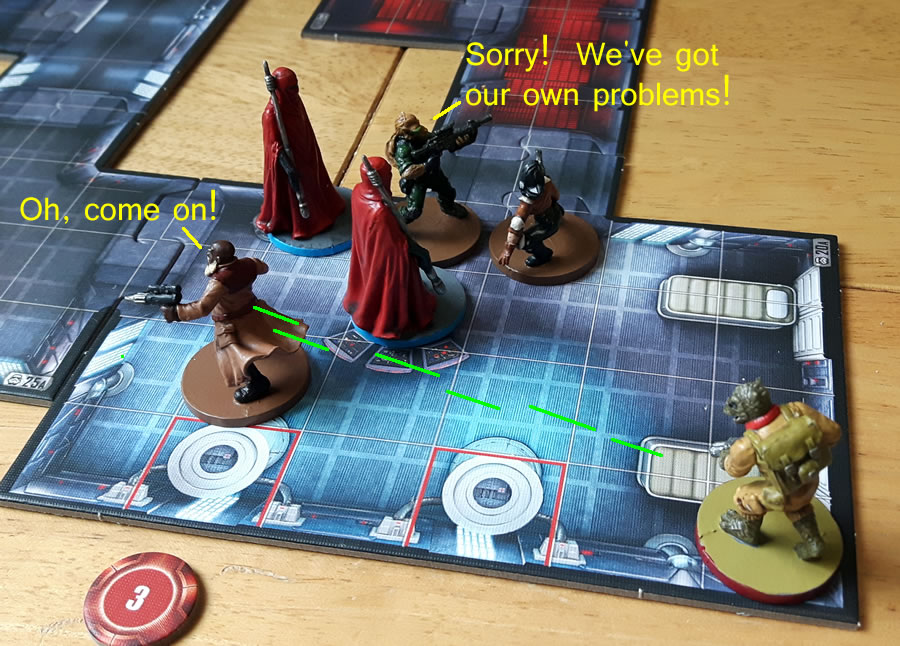
Imperial Assault of course is just some 3D terrain away from being a full fledged wargame, after all it does contain a head-to-head skirmish mode.  However, here it is another episode of our ongoing campaign, with the players trying to break an imperial agent out of a cell before the Empire can pump him for the information needed.

 
The players found they were up against considerably tougher people than in some of their previous encounter, not least I seemed to have drawn on the Stormtrooper regiment who could shoot.  I don't think they missed many shots all game.

 
Additionally, in an effort to avoid the transmission of crucial data, the heroes moved around the longest possible way to the target, ultimately finding themselves surrounded.

 
The players released the prisoner, but found more royal guard and mercenaries blocking their way home.  In fact it looked like they would fail at the last moment, when he was raked with fire making a break for the exit.


Fortunately for them, he staggered to freedom, and it was another victory for the Rebellion.  In fairness, despite several of the games to date being closely balanced, so far the players have managed to win all of them.  The strength of the Imperial Assault campaign system is that it balances very well to the gradual improvement of the characters, indeed a large portion of the cards and upgrades in the game appear specifically there to allow this.  The way elements are drip-fed to both player and games master alike are its greatest strengths.

AS a palette cleanser afterwards we had a quick game of Kharnage:

 
This is a relatively simple multiplayer card game, where each player forms armies to battle their opponents in a King-of-the-Hill battle for glory.  Players choose a strategy card to play and then deploy units based on it before unleashing a range of attacks.

This is not a complex game, it does not take much to explain or understand, but there is just enough subtlety and tactical nuance to be hold an interest for its short duration.  The artwork is pretty good to and there are a few nice surprises amongst the card.  Overall not a bad little game.

By comparison, Letters from Whitechapel features no combat, and is a far more intellectual exercise.

 
'Whitechapel' is a one against many game in which a team of detectives attempts to stop Jack The Ripper in his London rampage before his historically recorded 5 victims are taken, and 'he' goes to ground, anonymity and ill-deserved freedom.  To this end it operates with the Ripper player using hidden movement to track his route between his victims and his hideout, whilst the detectives control 5 officer pawns attempting to triangulate to his position.  

I our game we managed to close in on the Ripper on his fourth kill, and make the arrest, despite him having managed to throw us off the scent of his hideout.  We were close enough it turned out, and so in the end his own attempts at cunning placed him where we could not fail to catch him.  Whitechapel is a game with a simple premise and straightforward rules, but within that it provides a challenging game.

Finally, and well it was definitely going to happen, and after the investment I can't say I wasn't nervous, I got to test Conan.

 
Conan is an adventure game, again using a one-against-many mechanic, with most of the players controlling a single hero against the overlords' hordes.  However Conan does things a little differently to some games, and in certain ways is quite innovative.

 
For one thing the Overlord controls his minions via the dandy little dashboard you can see there, paying an energy cost associated to the position of a unit on the track to activate it.  Any activated unit then moves to the end of the track, making activating it again expensive, but all the other units now slightly cheaper.

And that of course mentions the energy mechanic.  On the heroes turn - and they all activate as much or as little as they want at the same time - they spend energy to carry out a variety of actions in any order, even teaming their actions to set up attacks.  However energy spent is recouped very slowly, so there is a gradual exhaustion unless a hero rests, doing virtually nothing for the round.  But if needed a player can throw it all into one glorious attack, and - for example - kill a mighty serpent with a single mighty blow.

 
Additionally wounds permanently reduce your energy supply, and in our initial game at least, there was little in the way of immediate healing to save the players.  At first Conan was able to hack through swathes of Picts in a single round; but by the end of the game he was scarcely able to limp out the village.

 
And pleasingly, this all worked really well.  Thankfully Conan operates effectively as a game, it is not too hard to learn, despite the initial rulebooks being a little confused in English translation (revised editions are free online), but it offers an engaging and suitably heroic style of play, one that leads naturally to the players generating narrative battles with evil.  Within our game alone, Conan operated as a one-man battering ram, whilst his thief ally did much of the searching and his wizard ally supplied the firepower.  As the overlord I was able to relish unleashing wave upon wave of troglodyte warriors against them, in a game that takes considerably less time to set up and play than Imperial Assault.

What it however lacks, is any way to string those games together as a campaign, rather each scenario stands alone.  This may well suit casual play, and it is understood solutions will follow, but for fans of games like Descent and Heroquest, this may be seen as an omission.

But I for one can't wait to get it to the table again.

Which is a huge relief!


Tuesday, December 27, 2016

Retro Corner - Operation Warboard


Every so often I manage to pick up one of the classics of Wargaming literature, from the halcyon days of my youth.  Operation Warboard by Gavin and Bernard Lyall is one such book and I had the great fortune to pick up a copy for a mere £5 on eBay a few weeks ago.

Mmmm, seventies paperbacks....
I say good fortune, for this is a book that trades hands for an awful lot more usually; AbeBooks typically offering ex-library copies for £20 or more.  This one was clearly a personal copy and although read, looked to have spent most of its' life sat on a shelf somewhere.  I consider I got a real bargain here.

So far as I am aware this was the authors' only foray into wargaming literature, but unlike most writers in the genre (Don Featherstone excepted really) Gavin Lyall - who certainly appears responsible for most of the writing, if not the rules themselves - has genuine form, having written a number of thrillers prior to this labour of love.  I cannot admit to having read any of those, but the narrative writing within the opening sections of the book gives some credence to the idea of the author as being an actual, y'know, writer.  In fact one thing apart from the clear narrative action and the friendly, breezy style, is the clarity with which Lyall writes.  Phil Barker and the entire writing team for Games Workshop should have taken note!

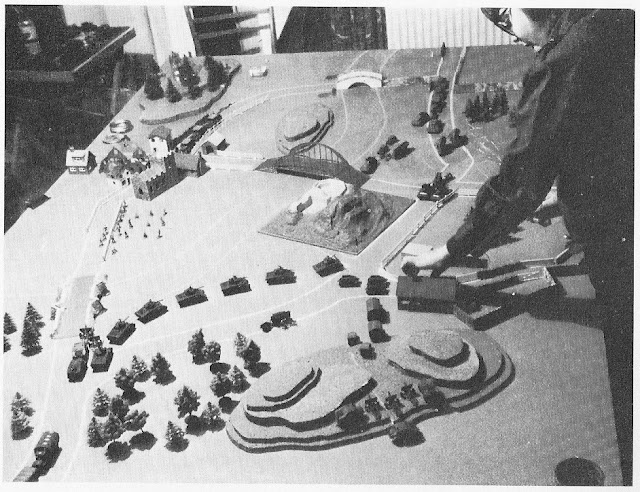
The book, rather obviously is a set of rules for fighting WW2 wargames, Lyall acknowledges the wider hobby of wargaming, but his interests are fixed to what in the time of publication was still recent history.  The book, as so many of its' period assumes no real knowledge of wargaming as a hobby on the part of the reader, setting aside chapters on procuring models (though not painting them, only the cover photograph suggests such effort), building a gaming space and making scenery.  As for the history, it is from an age before the obsession with pedantic historical accuracy masking simplistic rules (I'm looking at you Flames of War/Bolt Action),  The history is often fast and loose; unit sizes and available military equipment pragmatic based largely on what three or four plastic kit companies deigned to make.  Sure you can squint at a photograph and declare 'that's not a Hanomag' but really it's not the point.

Image result for "Operation Warboard"
Spot the 'Hanomags'

The rules themselves are certainly a product of their time, and anyone with a nostalgia for the older systems will be happy to set to work on complex machine gun and artillery grids to support play, but on other levels the rules show some evolution over simpler precedents.  Lyall's vehicle rules were hugely influential on my own rules as a kid, featuring different armour values for vehicles front side and top armour - with an attack-defence system anyone playing Bolt Action will recognise (Spoiler: Lyall got there first).  There are passable rules for the effect of morale on a force, and other features such as massed fire that speed up play, but in other areas things are very conventional.  Alternate turns, or simultaneous with written orders (very much en-vogue at the time) for example.  Also there are elements that require an honest opponent to really work, visibility rules certainly being left wide open to all forms of abuse.

One of the very best aspects of the rules however, and one more systems should adopt, is the extensive section preceding the rules explaining the logic behind them, what is and is not covered and how to address the unexpected.  Essentially Lyall recognised the need for an FAQ long before other rules gave the need any thought.  This really helps make the games' intent clear and certainly makes it clear the style of play envisioned.  If only more rules did this much.

The Rules were used in an episode of 'Battleground', now lost to the mists of time

Now I can't say I'll be jumping into playing these rules any time soon, but as a blast from the past, these were certainly better to read, and probably to play than many of their brethren.  I could see me electing to use these for a show for example, as a novelty!

Certainly one of the better old sets out there, and the nostalgia value is undeniable.  This copy will be staying in my modest collection of classic wargames books.


Tuesday, December 13, 2016

Kings of War Historical - A Review, A Game

Without that much fanfare, so far as I could see, Mantic recently launched their long requested historical version of the Kings of War wargames rules.  I managed to pick up a copy at a very reasonable price at Recon earlier this month, and was fortunate enough to have a game arranged shortly thereafter for which they could be put on the test bench.  Hence I'm in a position to give a review of the rules.

(Those who know the fantasy rules will gt a lot of the rule mechanics already; but I felt it worth reiterating.)

Firstly, you really can't fault Mantic for the production values:

The 128 page softback book, comes with lush presentation and more importantly clear and compact rules, which by the time they reach a historical audience have already been honed over several editions as a fantasy set.  Many of the niggles that beleaguer rules systems have already been ironed out, leaving Kow:H a lean tight system that benefits from it's predecessors.

Add to that the blend of generic troop types and 30 customised 'Army Lists' and the resultant package looks pretty good.  It even squeezes in enough of the fantasy rules to allow mythological elements to join forces with fact.

Of course all this may make the history buff, say, "ah, rules with fantasy elements?  These will never reflect real warfare then!"

And there are elements where that could be said to be true.  But they do not make for a 'bad' game.

What you have here rather is a simple core system, based on alternate moves where only one player moves or rolls dice, all of the action is in the hand of one player, from movement to shooting and combat, and any resultant morale tests (referred to as 'Nerve' in Kow:H).  Now that may sound one sided, but it in fact is so fast that play fair rattles along.  It is engineered to kill procrastination and stems from the original systems design ethos for fast play, a large tournament game was designed to take less than 2 hours to play.  Even played slowly the game is pacey, why?

The fast-play ethos, is in effect a command and control system, especially in large games.  The rules recommend using a timer for turns and there is a real point to this.  You move all your units freely (once per unit of course is a limit), shoot and fight with them, but you can only carry out as many of the actions as the time permits.  If your ten minutes for a turn runs out and you've not moved everything, tough!  It's now your opponents go.  So the rules seamlessly encourage you to play actively, and to prioritise key actions in a turn.

All this said, we seldom play timed games, but it's a neat idea.

This aside, you have very simple, easy to learn rule structures. Moving is by unit and is simply handled, all units are implicitly formed, and could be represented by single bases or multiple stands.  We elected to treat Skirmisher units - one of the few additions to the rules - as loosely ordered until contacted by an enemy, though the rules here do not specify any visible difference.

Units fire and fight with fixed numbers of D6 based on their profile, rolling against their proficiency to hit, and against the opponents defensive value to wound.  There are no Warhammer or Hail Caesar-esque saving rolls. Casualties are marked as hit points on the unit, no casualty removal, and any unit suffering casualties in a turn has to take a nerve test.  The attacker rolls 2D6 and adds the casualty number to the result, if it is equal to or above the minimum Nerve value of the enemy unit it becomes 'Wavering' for its' next turn and halts, unable to act aggressively on its' own next turn.  If the result equals or exceeds a second higher value the unit routs and is removed from play.  Fail to beat an opponent in combat and you recoil, not unlike DBA/DBMM, but remain locked in combat facing your foe, unless they retire.

One thing that KoW:H gets right, is the element that made the fantasy game work so well.  Flank and Rear attacks are deadly, and you will seek to avoid them at all costs whilst trying somehow to deliver your own.  How is this handled?  get on an opponents flank and your attacks are doubled; get in their rear and you can triple them.  Such simple elegance means that protecting your flanks becomes crucial to the game; and battle lines with reserves form far more naturally than in many 'gamey' systems.

Not that it is all perfect, and if one is being critical you can say that not everyone appreciates the IgoUgo template, and the near total control of your troops on a turn can seem too perfect, especially in untimed games.  Some may also dislike the exception rules and 'special abilities' provided for some units, though in reality these are generally appropriate and well balanced; not least as few of them in isolation are terribly powerful.

The biggest question, maybe a criticism in a few cases, is over the army lists themselves.  Generic units are the core of each list, augmented by a handful of special units unique to the individual army; usually including a commander.  These lists may raise some eybrows - for example the Egyptian list conflates the chariot armies of the Pharaohs with the cavalry led forces of the early Muslim armies, simple options like handgunners for the Japanese list are missed (though easily resolved).  Overall they feel like what they are, army lists with a sincere effort to reflect some history, but not created by experts in the field.  No doubt for friendly play they are easily adjusted, but they may well irk those who need every last detail pinned down.

So, the good fortune of timing meant that I had an ancients game agreed to, which would present a test of the rules.  Digging into my 28mm Ancients collection I was able to assemble a couple of small armies of the Peloponessian War (sorta).  1400 points each of Spartans and Athenians.  In classic fashion we deployed some classically sparse terrain, the only inconvenient element of which was the farm in the middle of my deployment zone, which split my deployment line.

We rolled one of the standard scenarios from the rule book, identical to those in the fantasy version, and found ourselves playing the 'Pillage' rules; essentially take and hold.  A simple case of occupying ground, at the end of 6 or 7 turns.  The scenario rules allow for a variable length game to ensure uncertainty, but still cap it to a low maximum - for time considerations once again.  Incidentally the rules also feature two additional scenarios unique to the Historical variant.

Battle lines are drawn
Anyway, even with a new player to Kings of War on my side as co-commander, we found the explanation of the rules straightforward.  We deployed in a standard alternate unit fashion - one could equally have drawn maps and used these to deploy simultaneously.  Forming plausible lines of battle; lacking the depth for reserves on the Spartan side, whilst the Athenian reserves pushed into the line as soon as the Phalanxes pushed past the farm.

Athenian mixed forces - Thracians on the right
One thing you become very aware of with KoW:H, as in the original rules, is the inevitable frailty of units.  They will all crumble as a result of casualties, though there may be early incidents where only a double 6 on the Nerve test - which always results in 'Wavering', and likewise a double 1 always leaves a unit with firm resolve regardless of damage - will effect.

In the Athenian case, fortunately high nerve rolls on the part of our Spartan player meant that many of our skirmishers broke and ran with only a smattering of casualties.  This impact is not perhaps as severe as in some other games, but it nevertheless is there, and justifiably so; there must always be room for the unexpected in this sort of game.

The result was that the Athenians had to close fast, before their heavy infantry came under too much fire.  The Athenians had more heavy troops, though of lesser quality, and so hoped to turn the flanks of the Spartans.  As stated the key way to win; destroy an enemy unit and you have the option to advance, retire, hold or wheel as a follow-up action, and obviously the latter allows you to turn onto the enemy flanks, or cover your own, as appropriate.  In these elements the simple rules expand into a more intricate game, terrain and opposing units can of course influence every action.

At the end of our sixth turn (we failed to roll for a seventh), Sparta held the majority of the ground, though they were under pressure on the ground, having lost more of their infantry than the Athenians, and with troops rolling up their flanks.  Another turn may have seen the battle swing either way, of course, and the game was open despite a hard start for the Athenians.

The whole thing was played out in under two hours.  Which certainly achieved the key design principles of the rules.  These are great rules for club nights and those occasions when time is at a premium, as well as tournaments - if you must.

In conclusion, we all enjoyed the game; they are not the most historical, or the most detailed rules out there, and I do not know how well they may stand the Charles S Grant Scenario's test*.  But they work, are easy to learn and fun to play.

Overall they come highly recommended, at least for casual play.


*if the rules allow you to play a scenario out of the Charles S Grant classic 'Scenarios for Wargames' book successfully, without modification, as easily as a standard engagement; they are flexible enough for me!


Sunday, June 12, 2016

Late to the Party - Dragon Rampant Thoughts

So the apparent drought of new material on the blog breaks with a bumper post about Dragon Rampant.  Yes I'm afraid for historical and big battle fans the blog is going to offer little for a while as this is the focus of attention in TML towers of late.

It took me a long time to get on the Dragon Rampant bandwagon to be fair, too much else to do to get any wargames in for a few months.  But an opportunity finally arose, quickly followed by another.

Now I am not going to promise a full review of the game, as frankly if you have seen my opinions on Lion Rampant there is only so much to add, the two games are 95% identical, there is just the addition of some fantasy specific elements and these only really serve to enhance the experience.  If you already like (or despise) Lion Rampant, then you really know what to expect here, and should have no illusions about what is on offer.

Rather a few words specific to my first couple of games.  As an opener I had a match against Ross, who for once was not rolling out his Ogres, rather a small collection of [obviously unpainted] elves, rescued from a dustbin!

Outflanking with a Dragon, what could go wrong?... 
We rolled up one of the scenarios from the book, notably, and probably to allow space for other items there are slightly fewer scenarios than in LR, but those present seem familiar. 

  
This one involved blocking the advance of the enemy with two flanking forces.  It did not suit either my force nor my tactical prowess.  However that may have been down to unit choices.

Dragon busy achieving nothing
One early point appears that putting all your eggs into one basket is a bad idea, My dragon was fully 10 of my 24 points, and proved next to useless, if they don't attack they are a huge point sink.  Granted, if hey do get stuck in they have huge potential, but unlike many other fantasy games, they are not near invulnerable.  The balance of DR is different to other games, many units are basically the same value regardless of race, and they all have access to the same set of special rules.  On the plus side this allows for infinite flexibility, but it does result in a degree of the generic about units.  Seasoned Warhammer/AoS players may not like that, others may love it!

Bellicose Foot (Faeries) against Elven Heavy Cavalry
 Manoeuvre, failed us both early doors, and as is a criticism of LR before it there is a reality of several turns going by with nothing happening, but the rules do not set an arbitrary limit on the number of turns so these shouldn't be seen as a real issue, just a minor annoyance.

Add caption
Combat aside, what really hamstrung me in this game was the enemy magic.  There are a small range of spells, each with its' own particular strength, I came up short repeatedly to 'Befuddle Thee' which rather easily allows a unit to become Battered - the Rampant version of Shaken or Wavering.

Consequently, my first game was enjoyable, but rather one sided.  Ross had enough games under his belt to have a solid idea that his force would work, whilst mine was a little less than effective.

 This in mind a week or so later I arranged another game, as part of a round robin at the club to introduce the rules.  For this I brought along a tweaked version of my first list, but additionally I brought a pair of forces both learning some early lessons, and showing the flexibility of the rules.

24 Points of Ogres
 My Ogre force centred on Offensive Heavy infantry, two units using the 'Reduced Model Count' rule to represent 12 figures with 4 models each.  The same rule turning one Ogre Captain into a unit of Elite infantry.  The warband finished by a troop of Hobgoblin cavalry with bows and lances.

24 Points of Goblinoids
 Similarly, the Greenskin force used the reduced count rule to Bring Trolls and Chariots, as well as a unit of spellcasting Goblin heroes and two units of Infantry; heavy and offensive Orcs and light and fearful Goblins.

In my game I took the Ogres for a trial, partly to see how the rules fared against the 'Ogre Test'.

Open battle in the Bloodbath scenario 
The Ogre test is a term a friend conjectured for the fact that in many fantasy rule systems or fantasy mods, Ogres seemed to be included as forces but written with disproportionate strength.  A classic flaw in Warhammer, and carried over to Sigmar, a problem to a lesser extent in Kings of War perhaps, though only for certain builds...

 
 In fairness, DR was unlikely to carry much of an issue due to the simple fact all armies derive from the same templates, if I build a army of Ogres and it seems overpowered, well you could just rewrite your elves list to represent exactly the same unit structure, and use the same number of models if you so desire.  No problem.  That arguably makes theme paper thin, but units having the same stats and performance but appearing hugely different on table never bothered historical gamers, this may be an expectation more of fantasy games!

More Faerie action
Unlike most large games, the action is fast and loose, units can see and be seen pretty much anywhere, movement is simple with only cohesion applying major limits, whilst shooting and combat rely only on one model of a unit being able to engage, for both sides to be fully involved.  These sort of lightweight rules may infuriate master tacticians who enjoy exploiting the wrinkles in a system, there are too few here for that, but they make for fast play.

A general advance against slow foes (and a tunnelling Wurm!)
Combat still splits dice into either 12 or 6 depending on the proportion of a unit still on table, and some again may find the idea of a unit down to it's last elf rolling 6 dice rather than 1 unusual, but it does mean that units always have a chance in battle, not least as the other key mechanic of combat relies on usually needing 2-4 hits on a unit to do any actual damage.

Another angle...
 My second game was a victory for me; admittedly against the army I lost with in my first, in other hands.  Happily just as much fun.  The pacey game had taken about 15 minutes to explain the basic rules of for the new player (Ricky) and then a little over an hour to play.  Whilst had tea and took club photo's Ricky and Matt had a second game, featuring my Greenskins against an alliance of Evil: Barbarian, Giants, Orcs and forest beasts.

Owlbears attack Orc Chariots 
Thrud makes Goblin paste
So, an overall conclusion?

I really like it.

This is not a simulation, it is not a representation of much in the way of real battlefield tactics, it is frankly rather gung-ho so far as skirmishing would be concerned too, were it not intended for a fantasy game context, in that case it works just fine and the open sandbox that the rules present allows for virtually anything to be represented.  Any game that gets me immediately thinking about buying and building a new army has to have something fundamental going for it.

Dragon Rampant certainly achieves this.  It's fun and it evokes the essence of classic fantasy wargames, without the need for endless fiddly rules-mongering or reference to endless tables and statlines, rules and errata.  Sure, they're not perfect, but what ruleset is.

In its own modest way, it is magnificent and well worth a look for any fantasy gaming fan.

Saturday, July 18, 2015

The Inevitable Age of Sigmar Review

I was determined not to write the rules off until I had at least given them a try.  Games Workshop's new baby has been out there for a couple of weeks now and I finally had a chance to try it a day or two ago.  What follows are my thoughts on that particular game and the rules as a whole.

We tried to play the game as written as much as possible, and so followed the rules as written to the letter, this seemed only appropriate for a review and initial test.  However myself and my opponent, Matt, did agree on one fundamental change: We would measure all movement and issues of contact from bases, not figures.

The rules state bases are irrelevant - except to stop the models from falling over - and that measurements are taken from any part of the figure.  Now this clearly will lead to issues, and seems on-line at least to have been interpreted as you 'always use the most extended part of the model'.  In essence the rules don't state that, but good old GW show all their previous form in this system by writing rules in such an ambiguous way that it is easy for them to spark arguments about intention and meaning.

Quite aside from the fact that this rule makes a figure with a levelled spear able to attack a model further away than one holding it aloft, and a flowing cape may make a figure have more range than the same one modelled without it... The rule as written makes little sense; but it is easily common-sensed around.  We opted for bases; this meant that figure size essentially became standardised and fair, and negated the potential need to stack one base upon another, something most gamers would be loathe to do.  Using your common sense is a strong theme of these rules, and in that regard they are very much of an old-school design ethos.  This is a point we shall return to.

Still, four paragraphs in and we've covered one rule.  Let's get things moving.

Beforehand we agreed to a couple of restrictions on our forces.  Armies in the game are made by choosing 'Warscrolls', essentially unit rosters, with the figures within that scroll having a certain number of wounds each.  What these do not have, is any form of points value, either explicit or implicit, so you really need a gentlemanly approach to how you prepare forces.

One of the big complaints of gamers seems to be that this makes pick-up games and tournament play impossible.  Well, we'll see.  For now we had 51 wounds each (just how it worked out) and 5 Warscrolls each.  Ogres versus Goblins; in Warhammer that would have been an enormous mismatch on face value.

We set up and rolled for the magical terrain.  Table wise, a small layout seemed more than adequate for forces of such a small size.  In AoS all terrain is special terrain.  This is not to say it is all wacky terrain, but as we rolled off the scenery we'd laid out it did throw up one oddity - The magical hedge capabl of improving a wizards casting ability seemed pretty unlikely.  The other issue with terrain is the rules as written really imply it should have a base; as written a wall provides no cover if you stand behind it, but if you stand on it, it does! The easy fix is of course that if in base contact with the terrain feature you are 'on the terrain', but equally having terrain fixed to a base makes more sense and avoids arguments.

We split the table in half and got on with deployment.  One point to note here is that you can declare you are stopping deploying at any time, you need not put out all your army.   The other guy can then carry on until he is satisfied.  If you haven't agreed an form of army size cap beforehand, you could both carry on until you simply run out of models.  As will be seen this is not a great plan unless you like to win because the other guy had to go home to bed.  But if, as Matt was, you find yourself out numbered by 4-3 or higher after deployment, you may elect to take a 'Sudden Death' victory condition.

Sudden Death conditions circumvent the normal victory condition of 'try to wipe out the other guy'; they include assassinating an enemy hero, and as Matt selected, occupying a key enemy terrain feature.  The down side to this is that the sudden death condition will often go with the army with the toughest models, and so may well play to their strengths  - in a balanced game this is more of a problem than in an unbalanced one.  Had I proceeded to put the remaining 150 goblins out my box on the table, Matt's strategy would have been wholly justified, but also harder to carry out.

Sudden Death is a good riposte rule to playing people who try to win by having the most toys, whether it works in even sized games is another matter.

Initial Terrain and Deployments 
 So we've deployed.  You'll notice there are no formed units, no massed battle-lines, AoS does not prohibit these, there is just no particular benefit to them.  Units will tend to close up in combat though.  I guess if you are playing a bigger game, trays would save time in movement, but for sub-thirty figure armies like these it was irrelevant.

The Goblin horde
 There has been a lot of more positive talk on the net about the 'synergies' between different units.  The way the Warscrolls are written is actually fairly clever (childish rules that some have aside), not hugely original, but clever.  Certain combos work well together, for example, I took Skarsnik, who can inspire a unit of night goblins to double their attacks and become immune to Battleshock (morale) over fairly long ranges.  this made my army much feistier than on paper it should have been.

This is smart, but then it is nothing that games like Magic: the Gathering haven't been doing for years now, so it is more a case of a application of modern game design than inventing something new.

A handful of Ogres
 As Matt finished deployment first He got first turn, but after that turn order is randomised, so it is quite possible to get two turns on the bounce.  This is not always good thing, and certainly I had good reason on one occasion in the game to let Matt sneak first turn when I had won the roll and could've elected to go before him.

You start the turn with Hero actions; these may be commands or spells, and are detailed as appropriate on a unit/characters Warscroll.  Some simply work, such as Skarsnik's powers, whilst others - magic mainly - require rolling.  Spells can be powerful, but are thankfully simple.  Casting involves rolling 2D6 against your target casting value, and your opponent may try to dispel it if he has a wizard in range by rolling over what you did.  Magic definitely played into the goblins hands on this day, but was far less overpowering than in Warhammer before.  Some may find it a little vanilla (most wizards will have the same two generic spells and one personal spell), but it works for such small games.

Anyway, knowing that the Sinister Shrine of Sigmar was his main objective, matt sent most of his force towards it.  Units have a basic move, which they may extend by D6 if they run.  Terrain has zero effect on most movement; unless as we did, buildings are declared impassable, linear objects simply remove their vertical height from the linear move.

Ogres loom in on their objective
 If you run you sacrifice your ability to carry out shooting or charge actions later in your turn.  If you get within 3 inches of an enemy model, without a charge, you must stop.  If you begin a turn in that position, you can stand still or retreat; that's all.

The Giant gets charged
 So to get all out of sequence, Matt charged my giant, my goblins having opened fire on some of his ogres over the way before also being charged by them.  A charge can be declared if you are within 12 inches of your target, but you roll 2D6 for your permissible charge move so it pays to move in close first.  Still even at 3 inches one of Matt's Ogre units failed it's charge and stood stock still.

Now in combat, any unit within 3 inches of the fight becomes involved and get 'Pile-in' moves to allow them to approach the enemy, but this is done in a neat sequence; the player whose turn it is chooses his first unit to fight, then the opponent may choose any unit of their own, engaged in combat, to fight back with.  Even if it is in a totally different melee.  Therefore, you may get the drop on enemy units even though elsewhere you have been attacked already.  The sequencing of this does nuance combat rather well.

Get 'em! Wheee!
 This, plus the special commands of Skarsnik made the Gobbo's more than hold their own against the Ogres on the flank.  As to the mechanic for shooting and combat, it is ludicrously simple, and seems to be a nod to Kings of War, but fumbled in a manner that can only suggest they had to avoid copying it directly, even if the result was far inferior.

All units roll to hit based on the weapons they are equipped with, so for example an Ogre is hitting on 4+, regardless of his opponents ability (unless any special rules on their Warscroll applied) - Vampire count or Zombie as a target, the roll would still be a 4+.  To wound is the same, only the Saves are really modified, where a weapon has 'Rend' which lowers the save.  Unlike previous rules, a 6 is not always a success, nor a 1 a fail, so it is very possible to be left without hope of escape.  But overall it did not feel like the Ogres carved through the goblins in the easy way they would have in Warhammer; Rank and file troops have evened out somewhat in this game.  And you may well feel that is a good thing.

It all boils down to two big fights
 What certainly is a good thing, is that big monsters, get weaker as they are wounded, rather than being immense or dead but nothing in between.  In their favour though, it seems that they are all of some use again.  My Giant proved useful in a way that he never did in games of Warhammer, even if he did die in the end.

Once in combat though, there is no escape until one side is wiped out [Note: subsequently I'm reliably informed you can disengage from combat if you wish, at any time, myself and Matt missed this, and it could change things somewhat].  Battleshock is what passes for morale, but from what I could see it would take a particular set of circumstance for it to be crucial.

The goblins were doing okay until reserves turned up
 If a unit loses models during the turn it must take a Battleshock test, rolling a D6 and adding the number of casualties to it.  Note this is not wounds, models must've been removed from the unit, hence solo models are technically immune to Battleshock.  Anyway, the result is compared to the unit bravery, and if it is higher than the bravery then the difference is the number of models that the unit loses due to fleeing.

In the whole game the was only one Battleshock test, I think this was partly due to the particular unit types and the special commands however.  As a morale mechanic it is interesting, but ultimately fairly insignificant.  The game essentially became a grinding match, and it was evident that it was one I wouldn't win.  After four turns Matt controlled his building.

Victory!
This was not an especially subtle game, and this is certainly a concern of the rules.  I used to regularly run my armies with large numbers of flanking fast cavalry, and it is hard to see how these may work here.  The game descended quickly into two protracted melees, and this seems a common experience to date.  Additionally there are some very odd rules.  Most notably, that troops armed with missile weapons can mid-fight, stop, pull out their bows or whatever, shoot at a completely different target if they wish, and then resume fighting.

Sure, there are ways of rationalising that in some cases, but the idea of Ogres loading cannon whilst fending of a bunch of goblins in hand to hand combat seemed doubtful at least.

Similarly, you can say goodbye to much of the Warhammer you know and love/hate.  No more Psychology tests, no fear, frenzy or terror, no warmachine misfires, no spell miscast table, no bemused monsters, no flank or rear charges, no challenges...  A hell of a lot goes when you trim down to four pages of rules, even if you can put some of it back in to the unit rosters.

Of course in some of the Warscrolls for the classic miniatures there are some very weird rules, some may say humiliating.  Such as pretending to ride a horse, or talking to your models, there are gamers who do that sort of thing anyway, but for some that would be a step too far, and is enough to put them of using those units, or even playing the game at all.  So special rules may need agreeing to work around.  Using common sense.

And so we are back to this point again.  There is the core of a workable game here, but it is not one that can simply be pulled out the box and played without a dialogue with your opponent.  My goblins fared better against Matt's Ogres than I expected, certainly better than I would've got in 8th edition, but to have had a real fighting chance in this encounter I would want another 10 or 20 wounds to even up the score.  But if I do that, there is nothing other than not owning the models to stop my opponent throwing another dozen Ogres on the table, and so it could escalate.

There is no way - at present - of saying an encounter is balanced, and there may never, ever be.  Scenario play is the balancing factor here, with the Sudden Death rule as a possible alternative.  But for the competitive gamer, there is no certainty in this.  It would be like turning up for a game of football, one team ready for five a side, the other with a full eleven; and the referee says play with who you brought, it's fair so long as the five as side team scores first they win anyway.

Can you have a decent game in this context? Yes, you can; but this is not the only issue.  As with so many of Games Workshop's rules there is a vagary in the writing that allows room for no end of ambiguity.  Those like me who were raised on the open rules of Featherstone and Grant can easily acommodate this but for many gamers the lack of a firm ruling in every situation will feel like it makes the rules unworkable,

Illogical rules like measuring from the model not the base, shooting out of combat and having to stand on terrain to be in cover will rile them almost as much as a lack of a points system.  Casual play against regular opponents will work best, whether this can ever be made into a set of tournament rules remains to be seen (I wouldn't want it to but that's a personal view).

But my main issues with the game are twofold, and they are not any of the above.

Firstly the game itself is slow, for what it is.  Given I played with 29 models and Matt with 11 this was a tiny game by old Warhammer standards, but with going through the rules carefully and talking over the results this game took two hours to play.  Sure you'd speed up, but the game boiled down to a long slow grind in the middle.

In the rules they claim a hundred models a side (perhaps a 2000 point game under old rules) should last an evening; it's hard to see that to be honest, plus after two or three turns it will boil down to a bunch of melees, in the middle of the table.  Now you can certainly argue that this happens in other rules too, but those rules generally feature retreats and flank marches and other legitimate events and tactics that will add to the unpredictability, it feels like AoS will become predictable very early in the game.

Secondly, and most damningly, why would I play this exclusively, even regularly, over the innumerable other games out there?  Ultimately, I don't think Age of Sigmar is terrible, I wouldn't even say it was not that good.  It isn't a bad game, but it is limited by a number of factors, and is certainly not a 'Great' game; not yet and moreover it may never be.  So why play this instead of sticking with older editions of Warhammer, or Kings of War, or Armies of Arcana, or Hordes of The Things, or playing Saga, Lion Rampant, Black Powder, Force on Force, Anima tactics.....  You get the idea.

This has been a very long review, but then it's fair to say both for Games Workshop and for wargaming as a whole this is a very important release.  This is likely to be the first introduction to Fantasy gaming for a lot of players, to wargaming in general for some, and it is a totally different ideology to its' owners previous products.  Equally it is a watershed moment for a lot of the company's loyal customers, and the point at which some of them may expand their horizons for the first time in an effort to use their collections in the way they always assumed they could.  Or quit the hobby in a fit of pique!  Games Workshop has apparently gambled on gaining more new players than it loses old.

Will it be a success for GW?  I think Age of Sigmar will need a year to bed in, and to develop, by which point it may be clear if they have a real success on their hands or not.  For me, as it stands it is a game I could play again, in a casual relaxed context, but is not one I would recommend in favour of any other system, not one I would adapt my established armies for, not one I would look to add figures for, and not one I would buy hardback books for.

GW needs plenty of players to think the exact opposite of this for its' gambit on providing the rules for free to be a success, if new gamers cannot be convinced that it is worth paying £6 a figure for the new plastic Sigmarite models - or for other new models or re-boxed old models - then they have failed, and the game will die.

There are a few elements to like, but this is no stand out product, and moreover it feels incomplete.  Were it not the product of the biggest company in the industry, Age of Sigmar would sink without trace.

Seldom has the phrase 'Damning with Faint Praise' seemed more appropriate.