Sunday, October 01, 2006
Harrogate Wargames Club
After a 35 minute drive and an hour long trundle around Harrogate and its' environs, I finally found the place. The RAFA club is one of many servicemens clubs in Harrogate, I should know, I visited three trying to find the right one! On entry I found there to be a large range of board and card games going on, darn I thought, no figure gamers.
But this was only the first floor, I soon found the historical gamers - at the bar - and was introduced around and given a tour. It turns out this is a healthy group of 30 to 50 (!) regulars with a more or less permanent residence in the club and the use of 5 rooms over two floors! masses of terrain, storage for regulars armies, and a huge selection of their own boardgames. Thankfully the emphasis did not seem to be on tournament play of a limited set of rules, but on a 'bring it and we'll play it' sentiment.
I was impressed.
Eventually we got round to a game, a modern version of the very trendy Flames of War rules, played in 1/144th scale (12mm) on a 8x6 table. British and Dutch forces against Russians in the sort of WW3 - cold war - scenario every modern gamer used to do in the eighties. Painted up, it all looked pretty good.
So after a couple of hours play I realised it was gone 11, and they showed no sign of stopping; I had to call it quits and drive home. A missed turn resulted in a 15 mile detour and rally driving conditions along pitch black country roads. Gulp!
Overall, I liked the place, and will give it another chance, but at this stage I just couldn't do that drive every week; even if I did get the right turns each way. Maybe as a monthly treat...
Next week I hope to try the Leeds club, and see how they compare
Monday, September 25, 2006
Resolution
When GW has a reputation for charging upwards of £2-3 for a rank and file figure, and even over a quid for a plastic trooper, it's refreshing to find that for £40 the new boxed set is crammed with over a hundred varied and well made models. Many of them are of course quite small, nothing like the massive orcs or empire knights of the previous edition, but in value terms I think its a better deal, producing two reasonably balanced armies to oppose one another. The sculpts show, particularly in the goblins, but also in the better of the dwarves (miners, cannon crew), that Games Workshop are masters of plastic figures in fantasy games.
Inclusion of cavalry, monsters, artillery and characters helps round it out in a way earlier versions never seemed to as a starter set. Granted many board games and figure systems now come with excellent plastic models - even painted ones - but the quality shines through for me here.
They may end up playing more HOTT than Warhammer, but they do look nice. I'm now tempted to buy a second box, funded by painting and ebaying the dwarves. It'd allow me to round out my goblins to a neat 200 foot, to accompany my orcs...
Sigh, here we go again. And still the Samurai stand untouched.
Tuesday, September 19, 2006
Frustration
Still, I came back looking forward to picking up a copy of the new Warhammer; only to find my favoured local independant stockist hadn't had his supply yet. I suspect the sneaky hand of GW holding back supplies to independant retailers - an old trick, to maximise their sales. Went to the other stockist nearby, who was shut. Drat!
Dilemma now is whether to order online from Maelstrom games (10% off) http://www.maelstromgames.co.uk/index.php?sou=worg post free and wait a week; or walk into a GW tommorow and take one away with me. Sadly that means buying it whilst at work and getting it home, trying to avoid cries of "GEEEEEEK" all the way.
Maybe I can wait a week for online orders to turn around...
Thursday, August 31, 2006
Down the tubes
I feel that Airfix have failed to move with the times, the ardent modeller is an adult now, and wants precise scaled, accurate kits with photo-etched parts and so on. Their models never held up detail wise, barring a small number of exceptions. Kids may not be into models, but there's obviously a tonne of money in the market that they failed to exploit.
My main worry is that as a user of enamel paints, I may finally have to switch to acrylics. If Humbrol don't surface from this debacle, I'm going to have to look elsewhere for a solution; thing is I've yet to be convinced by acrylics, having tried and disliked GW paints years ago. I may have to switch to Revell enamels for a while, or try Vajello...
Life will go on, I'm not sentimental for a badly moulded Spitfire, but I'm sure many are...
Sunday, August 13, 2006
Freshening up old armies
With the immenent release of 7th ed. Warhammer Fantasy, I dug out one of my oldest, ugliest armiest and refreshed the figures.
to be fair the characters and cavalry were all new and fairly recently done; the elite infantry were a few years old, but competantly finished. However the rank and file skeletons in my Vampire Counts army looked rotten. They were some 18 years old, crudely painted and badly based.
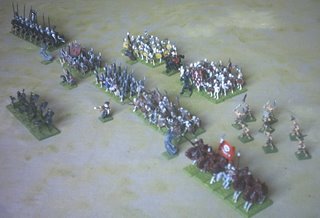
The full array; being Vampire counts this small number of figures is worth over 3000 points.
To freshen them up, I repainted the dismal shields and drybrushed the bones white - to hide a dreary brown wash that had failed when first tried, and been left ever since. Simply finished I think the army looks pretty good now; tabletop standard only, but not bad nonetheless. The main thing that draws this army together is the cohesive basing scheme. An extremely simple one, just a layer of filler for texture, painted green and drybrushed yellow.
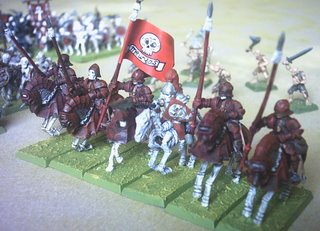
Black Knights, converted from Empire knights and Skeleton Horsemen. Black Tree Ghouls in the background.
For a weeks work, I've got a 3000 piont selection and something I can stick straight on a table in a GW shop without feeling ashamed. They won't win any prizes, but they'll play well enough!

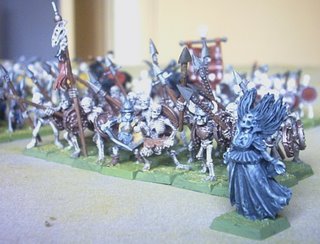
A Banshee supports my only recently painted Skeleton unit.
Monday, August 07, 2006
Barak Sawa 1944 - Crossfire
Using crossfire it is pretty easy to assemble force, so long as you apply a 2 to 1 ratio in favour of the attackers. Their brief was to seize what they were informed was a lightly defended island; as such the attackers were thus:
91st USMC battalion
Force Arthur:
- Company commander with observers
- Weapons platoon with 2 HMG squads and a mortar squad
- 3 Platoons, each of 3 rifle squads and a platoon commander, 2 out of 3 platoons had bazooka teams
Force David: the same
Force Hunter:
- M3A1 Stuart tank squadron
- M16 Half tracked air defence
Fire support from minesweepers Elliot and Bakersfield (equivalent to 10 heavy artillery fire missions)
Total approx 220 points
The defence did not meet the enemy suppositions of being light, and as stated before on this blog, the defender in Crossfire games does hold a lot of the cards . The japanese had a reinforced company available on the island, tasked with protecting lines of communication on the southern coast of Biak:
67th Infantry Regiment (elements of)
- Company commander with standard bearer
- Support Platoon with 1 HMG squad and 2 knee mortar squads
- 3 rifle platoons, each of 3 rifle squads and a Platoon commander
- Company artillery; 70mm mountain gun
- Mixed tank squadron - 1 Type 97 Chi-Ha medium tank and 1 Type 95 Ha-Go light tank
- 1 47mm anti tank gun
Total approx 110 points
Chris and Phil took the roles of the Americans, I got to defend. They were sent off to one room with an arial reconnaisance map and a briefing to formulate their plan and detail where their boats would land. I took the time to select my dispositions. As mentioned in the past the defender is deployed hidden and can within reason maneouvre freely when the enemy can't see him. I deliberately denuded one defensive position, knowing I was spread too thin to achieve effective total cover of the island.
The Americans had been given the day (20 initiatives) to seize control of the island, the main objective being to reel in belts of mines securing approaches to Biak Island north. if these were removed the approach of the main assault would be with fewer losses. They decided on a tactic of attacking only the Western flanks of the island in force. an initial probing landing was delivered by force David near the only natural bay of any size. A platoon of Marines was allowed to hit the beach before Japanese gunfire from caves and a bunker stopped them in their tracks.
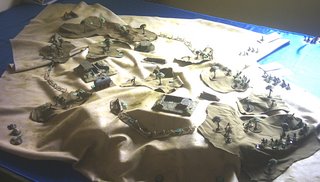

The Americans began to deploy on the headland, and used reconnaisance by gunfire to discover a Japanese patrol in the largest area of jungle. Nevertheless, the enemy slipped away. The Americans were beginning to think they had been lucky in their decision to attack this, the most accesible and seemingly undefended part of the island.
Their next move was to push force arthur into the jungle and land elements of Arthur and David on the beaches between the bay and the headland. An assault into the jungle produced an early success for the marines, but the Japanese simply melted away. As the Americans moved into the woodland, and ambush opened up on them, mortars, rifles and pistol shots stopping them dead.


Command and control was the down fall of the Americans; they showed themselves unwilling to advance into fire, and both commanders failed critical motivation rolls in succession. Costing the marines almost half their initiatives during the game. In the large jungle the troops refused to advance so force David was ordered to bring up it's commander and support weapons. They were fatally ambushed by the Chi Ha tank, who killed off two squads immediately, before melting away into the cover.

This prompted the Americans to land their tanks, redoubtable little Stuarts. The other Japanese tank and a 47mm gun tried to ambush them but to no avail, the tanks advanced. Meanwhile the troops on the beach near them were being slowly picked off by withering fire.
Light losses and a need for ammunition forced the Japanese to withdraw from the jungle, taking fresh defensive positions in the cliffs. Unknown to the Americans the hillside and the position atop it were defended by a whole platoon, and when a squad of marines tried to move to assist force David's mangled support troops, they were ambushed by savage gunfire.
Nonetheless, the Marines of force Arthur were finally able to make it to a position to see the enemy and attempt to call in minesweeper fire; meanwhile around the beach, the Japanese hardware assests were floundering, first the 47mm gun, then the Ha-Go, and at the end of the day, the Chi-Ha were destroyed.

Motivation in the face of fanatical Japanese infantry was still the biggest problem for the marines. Force Arthur stagnated again, whilst the hillside platoon picked them off. at least the minesweepers finally began firing, though the dispersed targets were hard to hit.
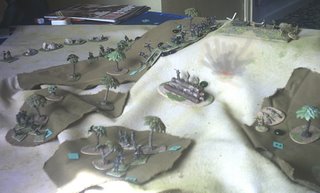
At last, as the sun began to set the americans attempted to seize the top of the hill. The withdrawn jungle fighters fired on them again; stopping the commander from following his men in. It turned into one attacking squad against the survivors of a Japanese squad and a mortar crew, defending a bunker. A brief, savage fight at bayonet point left only bloodied American joe's, crying for their mothers.
On the beach the last of the marines were being carrid back to landing craft bloodied and defeated.
As darkenss fell the marines dug in; the island was less than half theirs, they had captured no defenses and lost some 50 dead and 80 wounded out of an attacking force of some 250 men. On the other hand the Japanese had lost around 30 dead and wounded, and actually had as many fit troops left as the marines, having originally been outnumbered over two to one.

The American gains by the end of the day in red
However on the following day they would be out of artillery ammunition, lacking tanks, and only possibly able to recain the 47mm gun. On the other hand the Americans would commit the rest of the 91st, and two companies of the 93rd in an attempt to wrestle the island from the enemy.
...
Phil and Chris conceded defeat, and agreed it was a well balanced game. We all felt that motivation had been the Achilles heel of the marines. Who repeatedly failed to get moving. As far as mistakes, well they did forget to land the M16. These vehicles were known as "meat choppers" in the Pacific; a rather pragmatic, ghoulish term for their ability to stop japanese attacks and clear defences. I felt they missed a trick in leaving this off shore.
...
In one obvious respect this was an ambitious game. The forces were not large, but the terrain was demanding. Not wishing to spend months, or hundreds of pounds on custom terrain I couldn't use for much else afterwards, I stuck to cloth, boxes and books. The folds this created lent a slightly untidy look to the table, but added to the realism, Crossfire is a game that rewards fiddily terrain. Not having ten landing craft models handy either, the USN Pepperoni (box) supplied a disposable navy. The original inspiration for the scanario was again CS Grant's Scenario's for wargames, an excellent book full of ideas for any game system.
Finally the Crossfire army lists. All through the above I have referred to the forces as they are composed in the rules, and as they operated in real life, but in the photos you'll see the troops grouped in threes. Three men represent a squad of 8 to 12 men, 4 figures a squad of 13 to 20 in the game, one tank probably represents three in actuality. I find this is a reasonable compromise of scale, and as a whole the game plays very like historic tactics. The defender has to exercise some restraint in hidden movement (it would be easy to rig it), but otherwise it feels very realistic.
And never one did I have recourse to use a tape measure!
Monday, July 31, 2006
Cityfight
Firstly, they're not rocket science!
There are few surprises in the rules, it's a given that GW systems tend to be simple. This is not to say they are not sometimes elegant games. Epic Armageddon and Warmaster both show how they can be quite capable of writing rules. Mainly though these are an exercise in putting a new spin on tried and tested rules; with a view to selling lots of pretty (and pretty expensive) scenery.
Not that I needed to worry about that, a huge pile of foam board still awaits the modellers knife. Thanks to pilfering old placards from my last office when they threw them away. The table was set with a variety of terrain, some of which I'd knocked up the day before.
The rules specify a set up with no two buildings more than 6 inches apart. This allows for spaces and roads to naturally appear. Players then pick a number of specified 'Stratagems', little special rules to reflect nuances of urban conflict. The value of these will vary dependant on you army, I made two poor choices I think, booby traps, and a fortified building (which I then advanced out of! In the right circumstances these could be valuable, but they do create some oddities in play also. For example only the player with the plunging fire stratagem gains any particular advantage for firing down on the enemy from above?...
Orks, thousands of 'em. Actually for a 40K ork army this was a tiddler, we only played 1250 points each, which took as long as 1500-2000 points as a result of the terrain. Nevertheless I had around 90 Orks and a tank to play with. By contrast Chris' Blood Angels numbered around 25 infantry, two Dreadnoughts and 4 other vehicles.

Overall it was a cagey game, although the mission required our capturing the central building, the lack of fire avenues mean't the Blood Angels at least couldn't thin out my numbers and were holding back at first. He quickly lost his flanking land speeders, but otherwise was barely harmed by the Orks. My Warboss suffered the ignominy of being cut down by a squad of scouts.

Chris' Dreadnoughts seized the building towards the end of the game, my Ork Burna Boyz tried desparately to use their blowtorch burnas to cut them open, but to no avail. Although I wiped out one Marine squad, the Death Company arrived as reserves and as usual mopped up my Orks. At the end of the game Chris was the clear winner.
In summary, City Fight is what you make of it, but contains little in terms of rules one couldn't come up with by mutual agreement. It has been used as a spur by GW to develop new scenery and figures (Eldar Rangers redone, finally!); but that also means the book is largely just a fancy add for the self same items. As one would expect of Games Workshop.
Sunday, July 23, 2006
Went East, coming back now.
The Samurai however are presently on hold. Simple reason - paint. I want to paint them using shaded varnish techniques, one army in Red armour, the other in Black, there are historical forces to model them on, however, red is one of those colours. In enamel paint (my chosen medium) Red is highly variable, one tin can be runny, the next thick as pitch. I'm after a spray in a shade I like, to save time, but aside from the obscenly expensive GW red spray, I haven't got any options beyond car spray paint. I know it should work, and there should be a matt shade somewhere, but I lose the will to look.
As usual for wargamers distraction is the enemy of completing jobs.
I, ahem, aquired the first half of an army of Spartans. 60 figures 28mm from Black Tree Designs for only £40! Pretty good value. Sadly that means yet more red paint! Thankfully, metal miniatures and requiring a white undercoat means the pain won't be so bad. However the intention is to produce a display standard army for Warhammer Ancients, so no dip technique for these boys. Full on layered highlighting techniques, none of that cartoony black lining technique some 'professional' painters provide clients. An army of 120 men will take some time to finish, yet it holds a lot more appeal than starting the detailed and fussy samurai...
Meanwhile the 15mm Eygptians are now upto DBM army strength, with 10 chariots and 175 infantry. Good stuff.
The other issue however has been that napoleonics game. As a result books for research have arrived in the house. To touch upon a period of history that always struck me as intriguing. The wars of liberation in South America 1810 to 1840. Shambolic napoleonic warfare on a managable scale. Interesting? Hope so.
On the other hand, some items are going. Some of my fantasy collection, my 6mm ancients are selling up a storm on ebay, and next to go. Well possibly my Mongols; a full 20mm DBM army I've little interest to actually use and even less interest to paint an enemy force for. Kinda like fashion, they're on a shelf now with a time limit on them, if I don't touch again for a while, they're going.
We'll that's where things stand for now...
Sunday, July 09, 2006
1831 - the Battle of Nijlen
Phil brought along his Dutch-Belgian allied army, and split it for the day into a Dutch army and a Belgian one, to allow us a reasonable representation of a hypothetical battle of the Belgian Revolution of 1830-31. In August 1831 The Dutch invaded the rebellious south, enjoying 2 major victories before the French intervened. Our battle would easily fit as a minor action of the brief campaign, and gave at least a whiff of plausibility to the proceedings.
It occurs to me that at this rate I could rename this blog "Belgium in flames", 3 out of 4 battle reports being set in the poor place. Belgian bashing? never! I quite like the place. Anyhow.
For our other player, Chris, I suspect the closest he'd have been to the Napoleonics before would have been the odd episode of Sharpe; ordinarily a Warhammer 40k player, Chris has over the last year or two shown me a natural tactical aptitude (40k must teach you something, eh? either that or he's a loss to the nation militarily!) . In short he's beaten me at my own game on many occaisions.

The rules we were using were Piquet, though simplified to a certain extent. Primarily in the way firing was resolved, and some common sense treatments in the morale area. A major aspect of Piquet, is the card driven actions, you may only do what the turned card permits, unless it is a wild card permitting any action. You can fire any time, but if you don't have a reload card you are left vulnerable by doing so.
The other major aspect being that the initiatives are random - each player rolls a 20 sided dice, and the highest roller has the difference between the two results to spend on cards and actions.
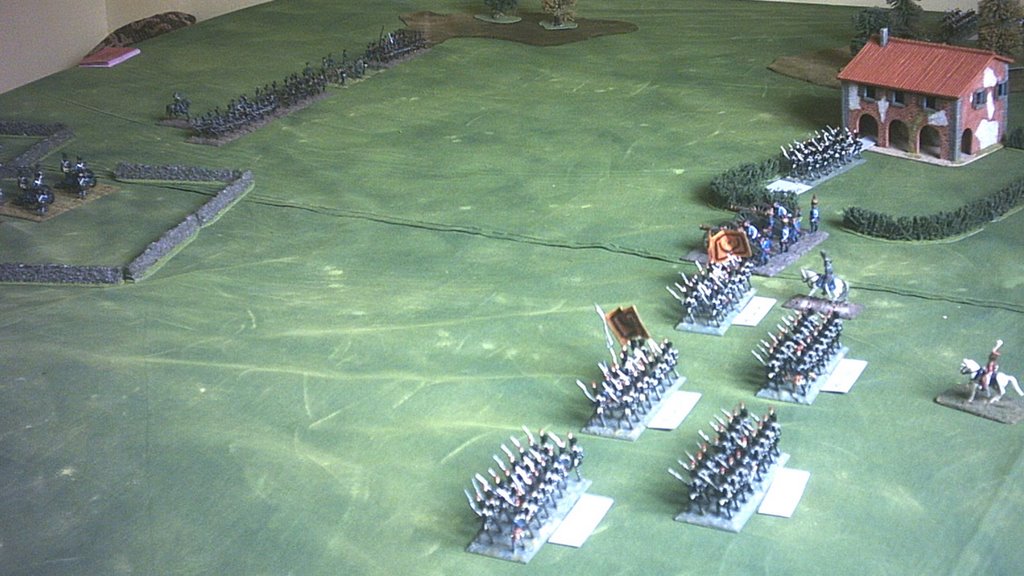
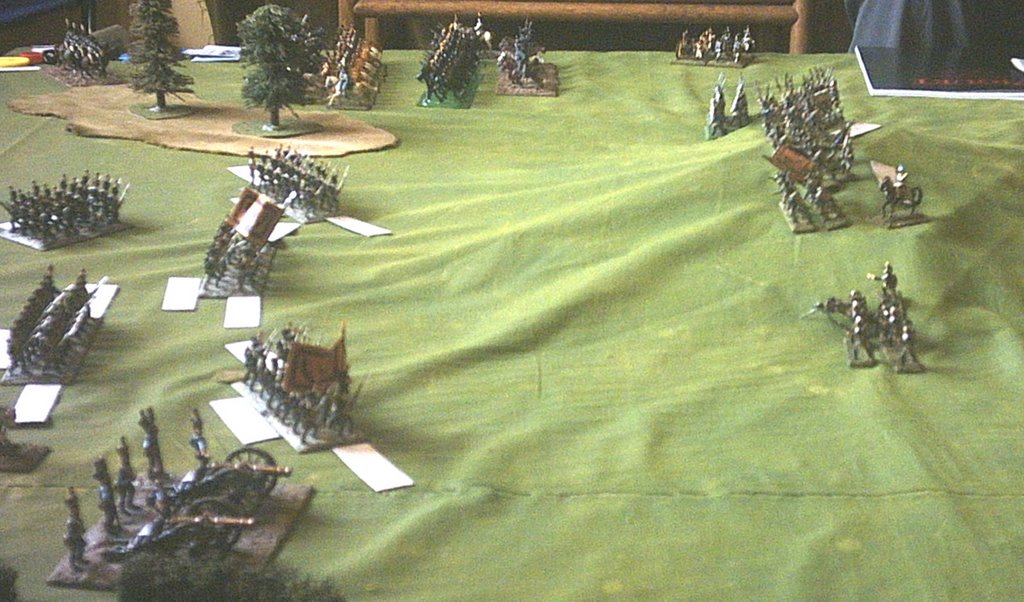
The first photo, shows my Dutch on the right formed into attack formations in depth. The Belgians are on the left, from this angle they look heavily outnumbered, but Chris favoured his own right with a larger infantry force, and a fearsome number of cavalry.

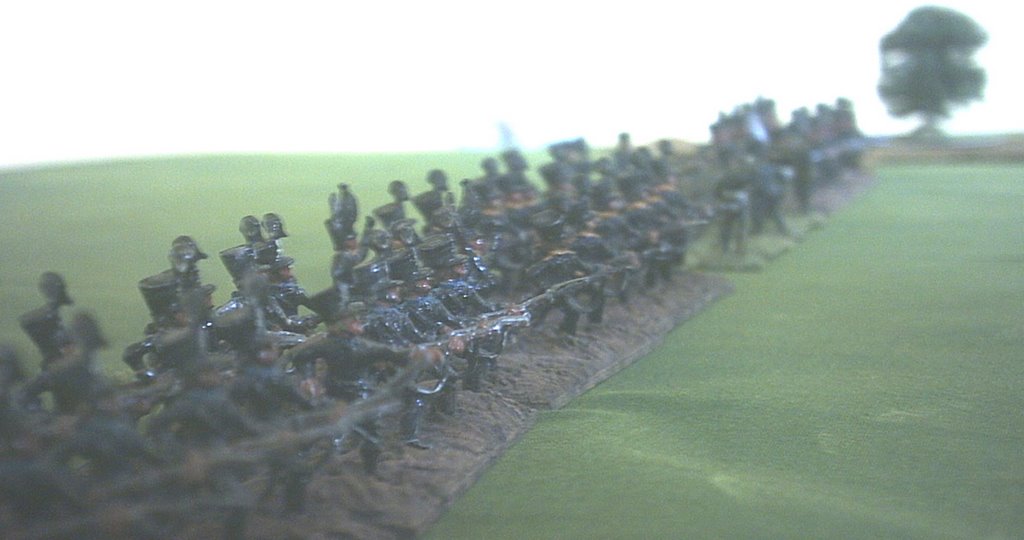
The Belgian front line.

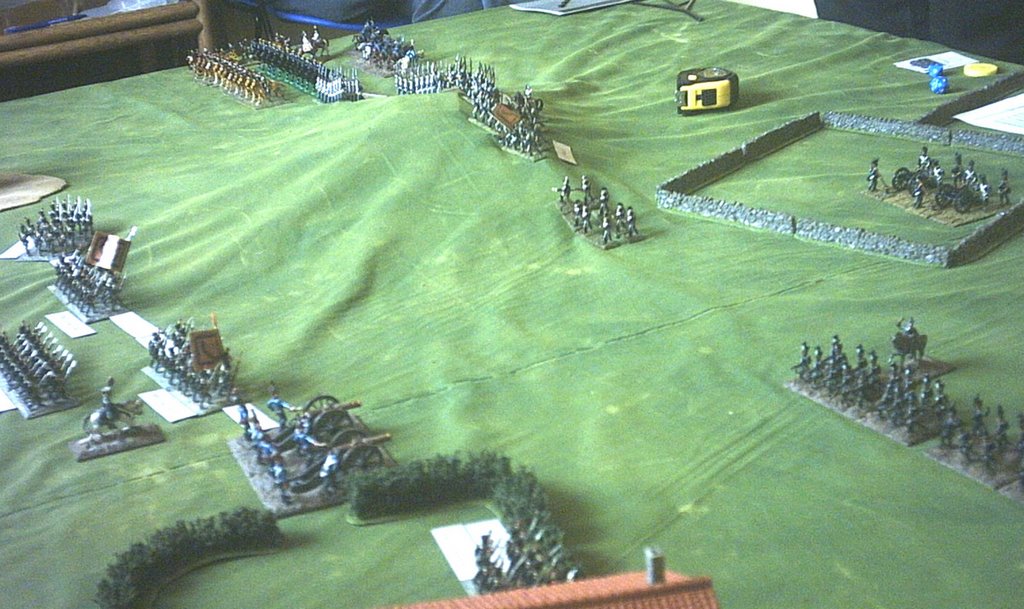
The Belgian Right.
Most of the Early initiative went Chris' way, an inevitable aspect of the rules being that whilst over the course of a game the number of turns will tend to average out, they can tend to form large blocks of action for one side over another. Chris got clean to the bottom of his deck of 40 cards, before I'd turned 8 of mine. This notionally ends the turn and prompts a reshuffle. Which Chris' deck clearly needed!In terms of action, after an opening redeployment of my artillery, some cannonade and a cavalry advance, it all swung to the Belgians Who began a general advance and summarily fought off my smaller cavalry force on my left. The rest of the game that flank revolved around how long I could keep his horse tied up without losing mine.
Dutch artillery on the right enfiladed the advancing Belgians. A devastating volley all but wiped out one of his battalions, routing the survivors. This spurred the Dutch right, now on the ascendent into action.With adequate initiative I began an advance. My right was strong, and his looked distinctly rattled.

Meanwhile my centre had become all the more defensive, forming squares in light of a possible threat from Belgian cavalry.

On my right I attempted to charge down his exposed artillery and out flank his weakened left. But thanks to the permitted interrupt actions - few in number but critical if timed well - Chris was able to hammer my troops with grapeshot as they charged home.
It cost me one battalion wholesale, and another routed (though quickly rallied). I cursed my bad luck, having known I'd suffer losses going in, but to get fired on at point blank three times before falling back inches from the guns was miserable luck.
Cheers of "For dark chocolate, Monksbier and mayonaise on our chips" went up from the Elated Belgians.
Initiative began to swing back to the Belgians who bore down on my vulnerable cavalry, clambered over the steep hill in the centre, and consolidated their left.

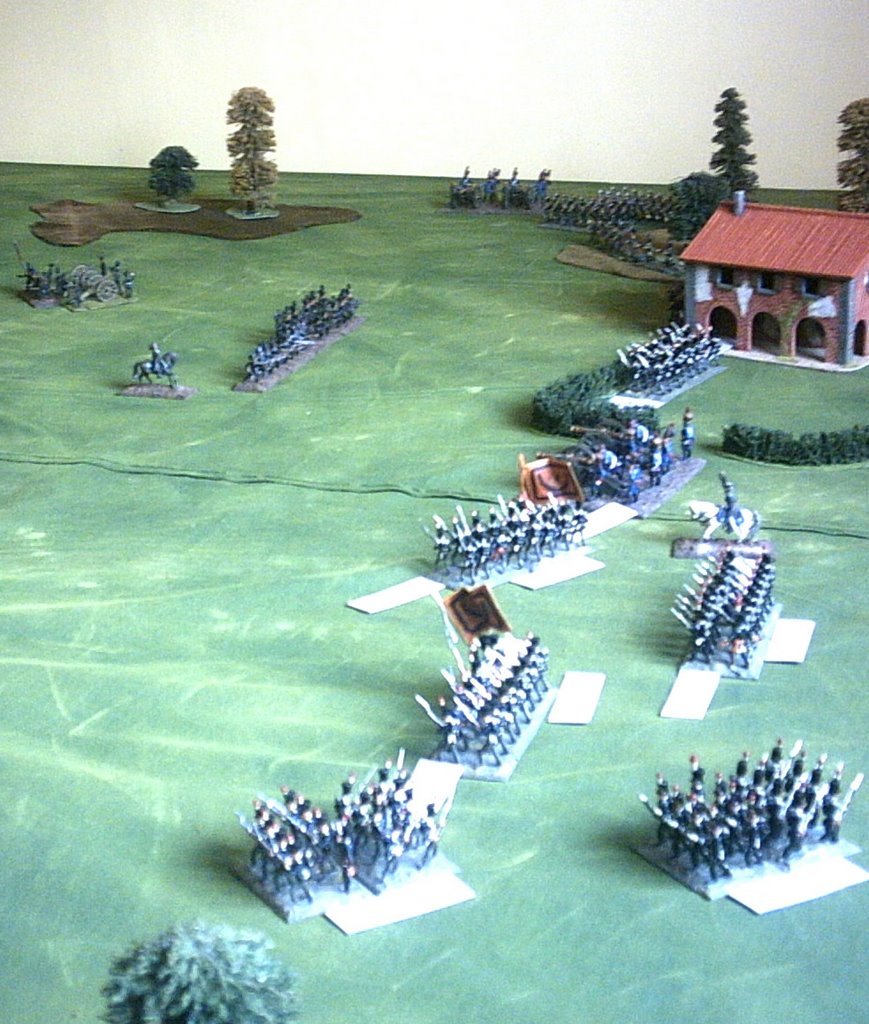
The Belgians begin to form a thin Black line.

Chris' cavalry charged mine, but Initiative fell with me for the end of the game. I ignored meelee resolution cards in my own hand, and he failed to draw any. I advanced on the right again using massed musketry and artillery to pound his infantry before closing. Time ran out for both of us.
A consultation of the morale chips and losses showed casualties were pretty similar, but the Belgian morale was stronger; although they'd not seized the field, they were the one who could better lay claim to the ground at the end of the day. We agreed it was the very narrowest of Belgian victories.
Piquet worked better than I remembered, though granted Phil, who stuck to umpiring, had simplified the mechanics a fair bit. Napoleonics is a period I always liked for the splendour (few wargamers don't I find) but found the prospect of painting the 4-600 figures my old club's preferred rules (In the Grand Manner) required used, to be both financially and ability wise, beyond me; and the rules themselves require an accountancy qualification to use. Here we both had forces of about 150 foot and 16 to 32 cavalry, with a few guns and got a good game out of it. My great weakness for figures leaves me watching a few painted units on ebay now.
Clearly the sign of a good, enjoyable game!
Monday, July 03, 2006
Upgrading the basics
Well actually I'd been intending to do something with it for a while. I'd picked up a 7 foot by 5 foot sheet of felt from a craft store some time ago as a base for desert games, in a light buff. I'll add at this point it's much cheaper to buy this stuff from source, than it is to let a wargames show trader cut it into 6x4ish lumps for you and sell it on. It's served well for a year or so, but increasingly I thought it looked a bit plain. It looked like I'd not made any effort; moreover, it was rather stark compared to the painted figures running around on top of it.
The method for this was partly experimental, though I'm sure many a wargamer has done it before, I didn't bother looking for any tips in books or on the web, simply got down to it. I took an old bit of sponge and a couple of tester pots of emulsion paint. Tester pots incidentally are a great way to get terrain paint cheap; £1 or so in places like B&Q for 75ml pots of generic household colours, and around three quid and you can have any shade you want blended for you in a 250ml pot.
Armed with my sponge, a tin of summery grass green, a pot of beige to lighten it with, and a gutted pizza box to mix it on and contain spills; I set to work.
It didn’t bode well at first, dabbing produced an effect that whilst the paint was wet looked too akin to polka dots; I tried rolling and the results were little better. The pressure of my fingers was forcing concentrations of paint down in regular 'fingerprint' sized blobs. It also took ages to cover any sort of area, five minutes per square foot, and I had 35 sq feet to do!
Thinking that at least the other side would remain fine, I persevered. and sped up, quickly discovering that scrubbing the sponge over the surface with more or less out of paint produced faster and better looking results. It also made it easier to build up graduated tones. The rest of the sheet took ten minutes to get a basic 'dry brush' styled coat on it.
Now I attended to the original blotchy areas, figuring I could turn the worst offenders into areas of greener growth by scrubbing over the top. this seemed to help too, and to balance the sheet out some similar areas were added to the other parts of the sheet. Finally I started to blend beige into the green and over dabbed and scrubbed areas to build up some highlights, and reduce the starkness of the boldest green blobs. A final pure beige scrub gave a few areas a lighter than base colour.
Once it'd dried I was pretty happy with the finish.

You can see the difference to the folded over untreated side. Next I may move on to improving my green sheet below it, I gave that a brush of the green a while back, but the brush strokes were harder to mask than the scrubbing of the sponge seems to have been, and one coat of green seems to have left it looking still too dark. Theres a couple of my Japanese bits on the table for interest, though to be honest the picture quality is not up to showing them off at this range.