Tuesday, May 02, 2017

Hastinge in Ireland - Part the Second: Baggage Train

Two months* passed, the weather and the belligerent Irish kept Lord Hastinge holed up in the largest local village he had made his base.  All the Irish under O'Reagan need do was keep piquets to watch the gates to know his business, and business was poor, for suppliers were slight and his men wanted for much.

With spring weather and an improvement in the seas and roadways there was a hope of getting a convoy of vital supplies through.  With an adequate escort there was a chance for Hastinge to break a de-facto seige of his force and return to a more active stance.

 
But O'Reagan would be aware of his every move.  Nevertheless horsemen were able to communicate with a supply train and additional forces made their way north to relieve Hastinge and his men.

Part of the wagon train advances
 The English were able to advance their wagons for many miles without incident, but as they closed on 'home', O'Reagan's men began to appear in numbers.  A retinue of knights advanced to clear the ground before the wagon train, whilst substantial infantry forces acted as their entourage.

The Knights dash off
 Of course the urge to engage and gain glory soon resulted in the knights leaving the convoy far behind.

Irish axemen would prove rash adversaries
 A band of axe armed warriors attempted to draw the knights into a scrub of woodland on the fringe of a farm, but instead were caught in the open and soon retired to the trees.  The knights followed and despite the difficulty of the ground, pursued the tribal rabble to the finish.

Other issues may arise
 A mixture of skirmishing kerns and tribesmen were by this point harassing the convoy and normal order was momentarily lost.  However the English axes and Bills were enough to hold the Irish at arms length.

Encircling
 The English knights began to flank the Irish, who had stationed their own men at arms squarely on the road.  A series of charges against these more heavily armed foes thinned the horsemen until they finally broke away.

Run away!
 However this had bought the main convoy time to outrun the warriors behind them and get close to the relative safety of Hastinge's hold.  Some of the wagons made it through the Irish lines, though others would fail at the final gasp.

So close...
A handful of wagons got through, but most of the infantry were able to fight past at the sacrifice of their supplies.  Hastinge would find himself reinforced, but in a parlous situation regarding his supplies.

______________________________

From a Glory standpoint it was another victory for the Irish.  And so for the next battle the initiative will be with O'Reagan.  The English were able to make their opponents run before them, but not able to achieve a great degree of harm.  At the end of part two of the campaign therefore the results now stand at:

Ireland: 6     England: 0


*Actually, two WHOLE years!

Saturday, April 29, 2017

More Conan Foes, more MSc Woes....


Such are the delays on the blog, that I have games and painting from the last two months I've yet to put to the record.  Of course I blame - and no surprise for you regulars - the Masters degree; but I only have two weeks left, and 99% of the work is now done, so the end is in sight and soon the most writing I'll need to do outside of work will be on this very blog!

Therefore, here's another batch of Conan figures I blasted out in basically a week, as an aside to my study.  Probably too intense an effort, rather like the bad old days when every spare moment seemed to involve painting!

Grrrrr...
So basically this lot also serve as yet another Dragon Rampant Game, and unlock a couple of scenarios from the Conan game as well.  Two units of Light Undead, two of Elite Mummies (no undead rule) and a Summoner Light infantry unit (the demon is a 10 hit element!).  Nothing any different here painting wise, the 50/50 wash-varnish does all the hard work and covers a lot of artistic sins.

Quantity has a quality all it's own as they say (I hope the same is true of the 30,000 words in my dissertation), and thinking back to the old days of the pledge, I've managed to paint over a hundred mini's this year, yet only bought five.  Good odds.


Wednesday, April 26, 2017

Sold Wargames Armies are like Ex's

Sure they may have made you angry.

They may have betrayed you more than once.

They might have been a bit mad, and/or inappropriate at times.

You may look back on them know and wonder what attracted you to them at the time.

They may not seem so attractive in retrospect.

They may have cost you a fortune, and been a drain on your resources you could rationalise any better than any other of their potentially innumerable faults.

Heck, you may never have so much as played with them (ahem).

But you still miss them, sometimes.

They might be the other side of the world now, or just around the corner with a 'friend'.  But you'll see them out, or in photo's, on someone's feed, or somebody will just mention them in passing; and you'll think of them.

'Man, we had some good times'.

Even if really, there weren't.

Friday, April 21, 2017

Pre-Industrial Mediterranean Buildings


I picked up some more goodies from Warbases a few weeks ago, with a view to solving a couple of gaming problems.  One was some movement trays for Kings of War, the other a club scenery need (well, for me and my opponents anyway!).

I picked up some items from their new modular buildings range, a selection of simple structures that are basic but represent great value.  The simplest buildings I passed on as they would be easy to replicate; but that still left several pieces of great interest to tackle.  Enough to build a Greek style farm:

Additional parts are pretty obvious here

That stepped roof and the gate and portico would've been tedious to build in Foamcore, and doubtless not strong enough to hold together in the long term.  I can only recommend the Warbases range, given how cheap these simple models are they return on the investment whole heartedly.

I did nevertheless expand the set up to a walled enclosure, and a false front on the house to provide a little more imposing luxury.  The enclosure is large enough for a typical regiment of troops to occupy, whilst the walls are tall enough to ensure their privacy.  Also I carried out the zen task (view it that way, it makes it much easier) of tiling the roofs with thin card cut up into roughly equal squares.

To go with this I also threw together two more modest buildings, large huts; one with an attached pig sty.  Just reinforced foamcore with card doors and wooden roofs covered in card tiling.

Finished, plus two other small homes

The painting is my usual simple building style, though as befits some buildings of the period, the larger farm has indulged in a coat or two of lime wash to the the lower half of the walls.  These are the buildings I wanted the GW terrain effect paint for so the basing isn't what I hoped, but it'll look fine for the club.

Finished I think though designed with ancient Greece in mind, they wouldn't look out of place in Italy, Sicily, Spain or similar regions anywhere up to around 1850 or so.

Hopefully these will see plenty of action, but not too much damage at the hands of careless gamers!


Tuesday, April 18, 2017

Review - Citadel Texture Paints

I picked up one of the new range of Citadel Texture paints to try, on a whim really.  A weird whim as I rarely use their products, though I do have a set of their old washes I find useful for certain jobs.  In general I find their product good, but far too expensive.  However if it will tackle a specific problem nothing else will do conveniently I'll take the hit.

The texture range look like they might be such a product, and appear good value too, until you realise the posts cost £4.55 each!  yikes!

Another issue for me was sloppy storage of the pots on the shelves - kids!.  I wanted a cracked, sun baked earth finish, which in the range is offered as Agrellan Earth (or the much redder Martian Ironearth).  But I ended up with a pot of Agrellan Badland.  And didn't notice the difference until opening it.  Ah well, let's press on.

Know what you're buying before you part with the cash!
 Now the advice for these is to paint it generously onto a prepared surface, whose base colour will show through.  For that I applied a thin skim of filler and coated it a cheap burnt umber.  As you can see in the picture above; up to this point I was still thinking I'd be getting some nice hard packed Mediterranean clay.  Not so.  the Agrellan Badland is a gritty paint; basically with micro crystals filling it in various sizes.  The advice is less to bush on as to splat it on in lumps and move it around - stipple it - to get an uneven coverage.  In fairness this it did well, and once dry the coverage wasn't too bad.

You can see the texture
 At this stage I was curious as to what might be in the paint.  A quick finger test of a small amount revealed that the acrylic carrier was full of, well, grit.  Thankfully it doesn't appear to be microbeads, rather something organic.  So that at least is a good thing.  The size of the particles varied and they would further break down between the finger tips.

Any how, now it was time to apply some highlights to bring out the texture.  I started from a desert sand and worked up in my usual fashion.

Finished, other than static grass
The look?  Well it's pretty good, the combined effect is better than filler alone, but not as textured as fine sand.  It's less uniform which may well appeal to some.  However, and this is a big but, this is a long and expensive way of going about getting the same effect you could have got with either coloured fillers, basetex type products, or just sand and paint.  I'm not convinced this particular product is worth it. Not least as I used about a third of a pot on about the equivalent of a 10x20cm area.  around £1.50's worth.  The filler, sand and acrylic paint for that amount of space might add up to five or ten pence I guess!

But I will get a pot of the correct crackle effect paint when I next have a project it would suit, and try that instead.  If that works as it should I cant think of an easy way of replicating the effect and it could be more completely recommended!


Saturday, April 15, 2017

An ordinary tale of Derpabury folk

Fitting around my busiest period in years, painting has very much taken a back seat.  I feel like I say this a lot, but for anyone who is considering a Masters Degree whilst working; this is what it does to your life!  Free time is a luxury.

With a little luxury time I have managed some of the more simple projects open to me, no regiments of Napoleonic troops at present.  Rather I've set to diversifying my Lion Rampant force with some potential additional models to allow it to multitask in Dragon Rampant.

To begin with, a find in 'The Range' led to ideas of providing them with a mighty war beast.  I'll admit at first I had doubts I could do much with this; but it was only a pound:

hmmm
But in fact with a decent paint-job and basing to match the historical elements of the force, it looked at least 50% less awful.

Better.
Added to that I rummaged around for a few bits to add a Wizardling and a grittier beasty.  This is a Reaper Bones Toad Demon with a repurposed Perry Miniatures Monk as a wizard.  They are joined by a limited edition Mantic Games minstrel and a Reaper Bones dog; alongside established models this makes for a unit of, well, whatever one wants I suppose...
 
Thus my Lion Rampant English can now represent the valiant defenders of Derpabury, a fantastical land of knights, wizards and strange beasts.

 
Not much to add; but it's something....


Sunday, March 19, 2017

Lord Hastinge recruits - Bidowers

Returned to my Lion Rampant Feudal English for the first time in a while, I have some space in their storage I can fill, and experience tells me I need some greater flexibility.  Consequently I dug out some models that would be simple to work on and add some firepower.  Hence, here we have a unit of Marches Bidowers, armed with slings.

 
No doubt you can see these as the Gripping Beast dark age infantry they are, but there would be little to differentiate the Welsh borders population of 500ad from those of 1200ad, so this is no issue for me.  Plus their lord has benevolently issued them with buckler shields, sourced from one of the Perry sets, giving him somewhere to ensure they show his heraldic colours.

Obviously these were a pretty quick job.  But I've kept my standards up for the painting and basing.  Generally they look acceptable.

Monday, March 13, 2017

Kierion - 48bc


Ah, an excuse to push around a whole bunch of soldiers at last.  Myself and Paul arranged a game to introduce him to Kings of War: Historical a couple of weeks ago.  Looking at what we had handy it was agreed to play my Peloponnesian League (aka: Sparta) against his Caesarian Romans.  A slight mismatch chronologically, but less extreme than many and one which I at least was happy with, after all it was still two ancient armies, and neighbours to boot facing one another.  In a club where DBMM still sees plenty of action with Han Chinese facing Egyptians, late Imperial Romans or Caroligians on a regular basis, it sat far more comfortably with me.

So one could suppose a timely rebellion of the Greek states, taking the opportunity of Civil war amongst the Romans to reassert their independence, this would be one more problem for Caesar to deal with if he was to become triumphant.  Thus my Greeks could take the field against Paul's as yet untried Roman army...

Opening Dispositions
Having laid out some classically barren terrain Paul opened the deployments, my Greeks having out scouted him, forcing more of his units to deploy.  Not that this made a huge difference, as he outnumbered me anyway so we finished deployment about the same time.  Both armies formed a central line, with Paul able to deploy more cavalry to his flanks, but I being able to lock the flanks with units of spearmen.
The Roman centre

Greek Phalanxes

Early movements
I took first turn initiative, which was probably of benefit to my opponent, who was new to the rules.  I began a steady advance and threw out a little missile fire; my cavalry decided on a re-positioning to the centre of the line hoping to charge down his artillery park.  For his part Paul largely held back except on his flanks, anticipating and eliminating my cavalry thrust but little else.  So on my second turn where the cavalry failed I was able to throw forth peltasts to undertake the same task.

Skirmishers vs. Artillery
In reply Paul charged down the peltasts on my left, but the success left his horse dangerously exposed.

Chaldicians lure out the cavalry
The Chaldician phalanx hit them in their flank.  Far away on my right a Spartan Phalanx had skirted around the farm and driven Paul's' other cavalry unit back onto the flank of his infantry.  His centre line still stood firm, but the Greeks steadily advanced.

Roman flanks under pressure
Finally in turn 4 Paul let the men off the leash, and accepted that if he did not advance I would dictate all the terms of the fight, already I was manoeuvring to threaten the flanks of his line and advancing was the best way for him to clear the danger.

The lines close
Battle was joined at my lead.  The Roman auxiliaries were thrown in disarray when they found the two strongest units of the Greeks (the royal guard and a toughened unit of Spartan heavy infantry) to be their foes.  This allowed me to threaten the flank of the Roman legionary line, which otherwise largely stood firm.  One unit its' centre wavered, and would not charge, but none broke.

Roman auxiliaries break

Then the weak city Hoplites break
The Romans made redress and countered.  The city Hoplites on my left, already badly mauled by missilery on the way to contact soon broke, so I would have to push forward my limited reserves, but elsewhere the Greeks held firm.  The artillery finally drove off the peltasts (on reflection I think we played a rule wrong here and the artillery may have been a tougher nut to crack than it should've), but their chance to contribute to the main battle was now passed.  They had been neutralised for the most part.

End game...
On the final turn the Greeks broke the centre of the Roman line, and Paul was forced to use commanders to hold the crumbling right flank.  His final reply failed to break any crucial units, but time and the turn count drew the battle to a close.

A quick calculation of victory points showed it was essentially a tie at this stage, I had had scored 15 more points against him, barely enough for bragging rights, but had we played a 7th turn, with my chance to reply coming first, the situation on the field would've been dire for Rome.  Both his flanks were depleted and turned, and his Legion was reaching a crisis point with more threats than it could respond to, where he had extra utility it still had to wait for the Greek wave to crash against it first before its' chance to reply.

I think nightfall saved Caesar this day.

This was a 2,000 point game of KoW: Historical, and as a club casual game it worked very well.  Given the rules were new to Paul he picked it up easily, how sold initially on the relative passivity you experience on the opponents turn he was is something we debated; unlike virtually all other wargaming rules you cannot influence the actions of your opponent at all on their turn, but of course this cuts both ways, and has the advantage of speeding up play.  It is something you get used to very quickly I feel, but it is the biggest difference in the rules from their peers.

Overall, KoW in general is a system I will keep coming back to, for its' simplicity and scalability.  And anything that lets me get a full sized army into play in a short week-night timeframe is fine by me.

GG.


Thursday, March 09, 2017

Boardgame round up - Imperial Assault, Conan and more...


Despite being very busy, I am getting a fair number of miniatures games in this year, but at the same time I'm doing so alongside a number of board games, something I like to talk about from time to time.  Not too often, y'know, this is a wargaming blog really.  But then three of the following games at least bear some links to that subject at least, so let's carry on.

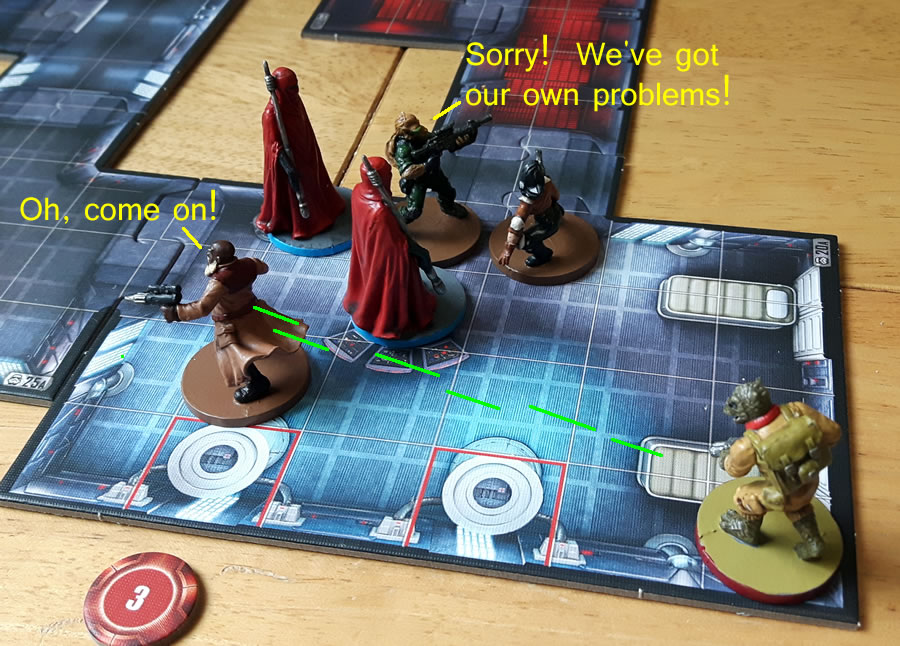
Imperial Assault of course is just some 3D terrain away from being a full fledged wargame, after all it does contain a head-to-head skirmish mode.  However, here it is another episode of our ongoing campaign, with the players trying to break an imperial agent out of a cell before the Empire can pump him for the information needed.

 
The players found they were up against considerably tougher people than in some of their previous encounter, not least I seemed to have drawn on the Stormtrooper regiment who could shoot.  I don't think they missed many shots all game.

 
Additionally, in an effort to avoid the transmission of crucial data, the heroes moved around the longest possible way to the target, ultimately finding themselves surrounded.

 
The players released the prisoner, but found more royal guard and mercenaries blocking their way home.  In fact it looked like they would fail at the last moment, when he was raked with fire making a break for the exit.


Fortunately for them, he staggered to freedom, and it was another victory for the Rebellion.  In fairness, despite several of the games to date being closely balanced, so far the players have managed to win all of them.  The strength of the Imperial Assault campaign system is that it balances very well to the gradual improvement of the characters, indeed a large portion of the cards and upgrades in the game appear specifically there to allow this.  The way elements are drip-fed to both player and games master alike are its greatest strengths.

AS a palette cleanser afterwards we had a quick game of Kharnage:

 
This is a relatively simple multiplayer card game, where each player forms armies to battle their opponents in a King-of-the-Hill battle for glory.  Players choose a strategy card to play and then deploy units based on it before unleashing a range of attacks.

This is not a complex game, it does not take much to explain or understand, but there is just enough subtlety and tactical nuance to be hold an interest for its short duration.  The artwork is pretty good to and there are a few nice surprises amongst the card.  Overall not a bad little game.

By comparison, Letters from Whitechapel features no combat, and is a far more intellectual exercise.

 
'Whitechapel' is a one against many game in which a team of detectives attempts to stop Jack The Ripper in his London rampage before his historically recorded 5 victims are taken, and 'he' goes to ground, anonymity and ill-deserved freedom.  To this end it operates with the Ripper player using hidden movement to track his route between his victims and his hideout, whilst the detectives control 5 officer pawns attempting to triangulate to his position.  

I our game we managed to close in on the Ripper on his fourth kill, and make the arrest, despite him having managed to throw us off the scent of his hideout.  We were close enough it turned out, and so in the end his own attempts at cunning placed him where we could not fail to catch him.  Whitechapel is a game with a simple premise and straightforward rules, but within that it provides a challenging game.

Finally, and well it was definitely going to happen, and after the investment I can't say I wasn't nervous, I got to test Conan.

 
Conan is an adventure game, again using a one-against-many mechanic, with most of the players controlling a single hero against the overlords' hordes.  However Conan does things a little differently to some games, and in certain ways is quite innovative.

 
For one thing the Overlord controls his minions via the dandy little dashboard you can see there, paying an energy cost associated to the position of a unit on the track to activate it.  Any activated unit then moves to the end of the track, making activating it again expensive, but all the other units now slightly cheaper.

And that of course mentions the energy mechanic.  On the heroes turn - and they all activate as much or as little as they want at the same time - they spend energy to carry out a variety of actions in any order, even teaming their actions to set up attacks.  However energy spent is recouped very slowly, so there is a gradual exhaustion unless a hero rests, doing virtually nothing for the round.  But if needed a player can throw it all into one glorious attack, and - for example - kill a mighty serpent with a single mighty blow.

 
Additionally wounds permanently reduce your energy supply, and in our initial game at least, there was little in the way of immediate healing to save the players.  At first Conan was able to hack through swathes of Picts in a single round; but by the end of the game he was scarcely able to limp out the village.

 
And pleasingly, this all worked really well.  Thankfully Conan operates effectively as a game, it is not too hard to learn, despite the initial rulebooks being a little confused in English translation (revised editions are free online), but it offers an engaging and suitably heroic style of play, one that leads naturally to the players generating narrative battles with evil.  Within our game alone, Conan operated as a one-man battering ram, whilst his thief ally did much of the searching and his wizard ally supplied the firepower.  As the overlord I was able to relish unleashing wave upon wave of troglodyte warriors against them, in a game that takes considerably less time to set up and play than Imperial Assault.

What it however lacks, is any way to string those games together as a campaign, rather each scenario stands alone.  This may well suit casual play, and it is understood solutions will follow, but for fans of games like Descent and Heroquest, this may be seen as an omission.

But I for one can't wait to get it to the table again.

Which is a huge relief!


Sunday, February 26, 2017

Step by Step Picts

Oh, hey!  I seem to recall saying I'd do this earlier. So here are the photo's of the paint sessions that went to assembling my Pict force for Conan/Dragon Rampant.  These don't form a step-by-step guide per-se, more a log of how long the process took.

Session 1 
The first session was fairly easy, being a fast application of generic fleshtones in artist acrylics.  This took only about 40 minutes, and it showed in the results - being in no way good enough to serve as anything other than an undercoats.  Still, a start.

Session 2
 Up to a couple of hours work here; during which the proper flesh tones were applied.  Working with a live palette, I painted four or five random warriors one shade before adding a little darker colour to the mix for the next batch.  The Hyena's used one of the base tones with extra browns to vary it up and make it more animalistic.  The shaman got a special pale shade and, well the snake is obviusly different,

Session 3 
A solid three and a half hours plodding through the loincloths, weapons and so forth.  Again, painting four or five items the same brown, then mixing a different shade into it to vary the overall look.

Session 4 
Another three hours was spent doing stone mace heads, warpaint, animal markings and so on.  The snake in particular is starting to come to life, but more needs doing.

Session 5 
A final blow out to finish the work; odds and ends like the skulls and bones are finished over the course of another few hours.  More detail on the snake and hyenas, and blue tattoos for the shaman.  Finally a 50/50 wash of glaze and Strongtone has been applied.  (not that you can tell in that rubbish photo!)

Session 6 & 7
And so to finish, the bases are textured with sand, painted with craft acrylics and then dry-brushed a light sand.  In effect two one-hour sessions.

All told that adds up to around 12 hours for a 32 figure army.  If I've recalled my effort correctly.

Not too shabby, though these turned out to be more complicated than I imagined simply looking at them.